
S8 E7 Supporting Learning at Home
In this episode of the Reading Teachers Lounge, we share key strategies for parents and teachers to support homework. Learn about the role of executive functioning, emotional well-being, and effective communication practices to enhance student engagement in a post-COVID landscape.
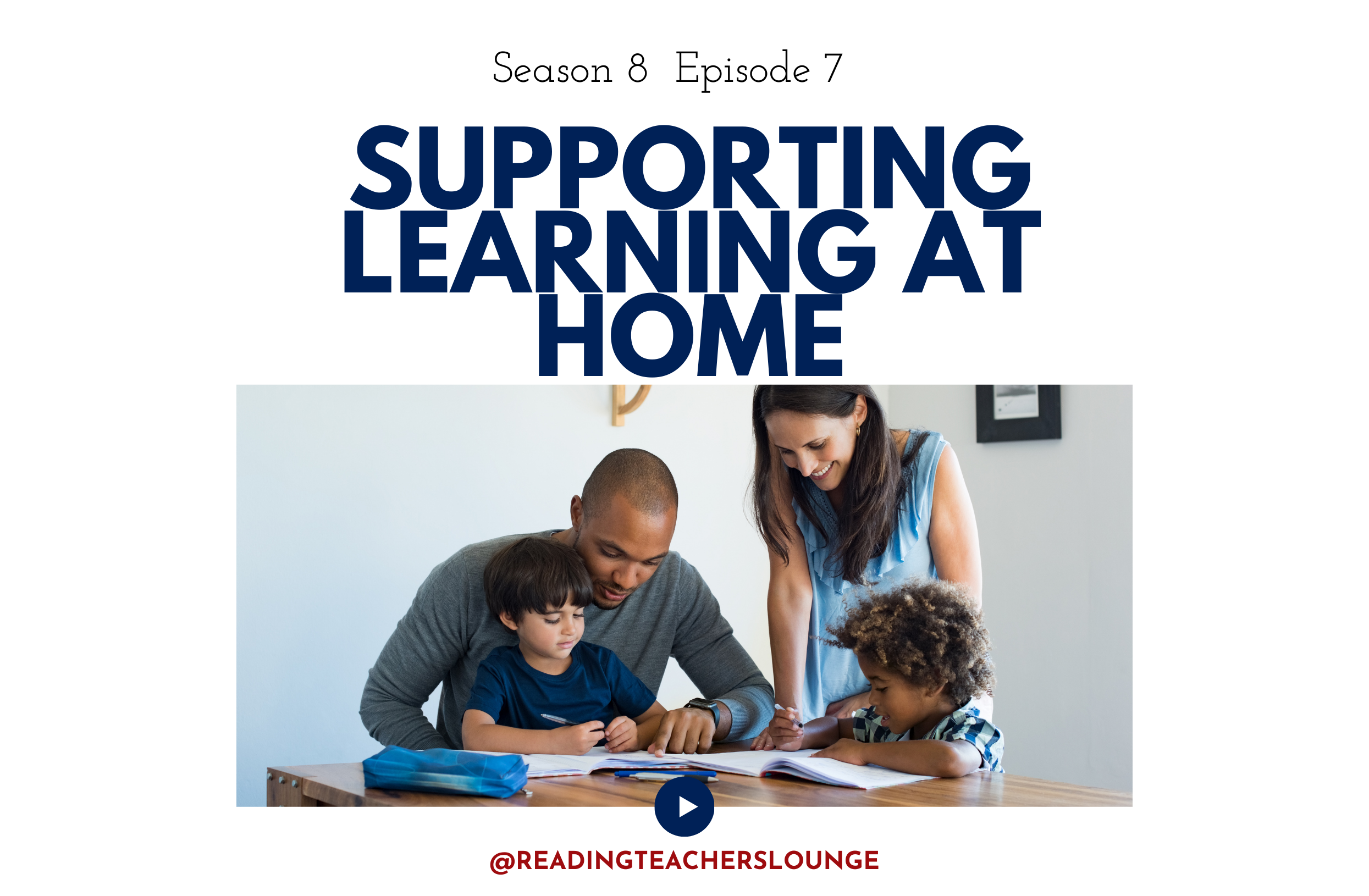
Episode 8.7 Supporting Learning at Home
00:00 Welcome to the Reading Teacher Lounge
00:39 Balancing Teaching and Personal Life
01:14 Supporting Learners at Home
02:20 The Role of Executive Functioning in Homework
03:47 Homework Practices and Post-Pandemic Challenges
05:27 Creative Homework Approaches
09:01 Simplifying Homework for Better Engagement
10:32 Flexible and Individualized Homework Strategies
19:24 Creating a Productive Homework Environment
25:28 Understanding Executive Functioning in Children
26:07 Dealing with Meltdowns and Connection Issues
27:37 Empathy and Minimal Help Strategies
28:07 Middle School Homework Challenges
29:28 Reaching Out to Teachers for Support
29:58 Effective Homework Breaks and Routines
36:55 Positive Feedback and Encouragement
43:52 The Role of Parents in Homework Success
44:22 Reading Logs and Encouraging Curiosity
46:59 Research on Homework Benefits
48:18 Conclusion and Resources
Transcript:
Disclaimer: This transcript was automatically generated. Please be aware that this transcript may contain errors, particularly with specialized terminology, proper names, or in discussions with overlapping speakers. The accuracy of the text may vary depending on audio quality and speaking style. For the most reliable and accurate record of the content, please refer to the original audio.
Correction suggestions are appreciated, and we welcome you to notify us of any errors spotted by contacting us at team@readingteacherslounge.com. Thank you for your support and understanding.
8.7 Supporting Learning at Home -
Shannon Betts: [00:00:00] Hey Mary, another episode of the Reading Teacher Lounge is here.
Mary Saghafi: This season, Shannon and I are diving into new topics and insights about best practices, sharing more teacher tested strategies, and bringing you engaging conversations with fresh and possibly returning guests.
Shannon Betts: Whether you, you're a teacher, tutor, or parent.
You'll find practical ideas and real talk to support the readers in your life
Mary Saghafi: because teaching reading is tough, but you don't have to figure it out alone.
Shannon Betts: Join the conversation and level up your teaching with us every episode in the Reading Teacher's Lounge.
Hey listeners, it's Shannon. If you're like me, you spend all day giving your best to your students, and then by dinnertime, you're out of energy to think about prepping nourishing meals for yourself and your family. That's why I started using Green Chef again. Green Chef offers quick, flavorful, and nutritious meals that fuel my busy teacher life.
Wanna try a free [00:01:00] box, check the show notes for the link or go to reading teachers lounge.com/quick links and use our link button to sign up and have your dinner handled.
Mary Saghafi: Welcome to the Reading Teachers Lounge. I'm gonna take the reins a little bit today and chat with you all about how to best support learners at home.
So we know that our audience has parents and we have teachers, and so we're gonna try to meld these two audiences to really talk about homework and how students can really have that homeschool connection between the work that they're working on.
Shannon Betts: So I look forward to talking about this. As a parent of, you know, children who do homework also as the tutor.
Mm-hmm. Because sometimes with some of my students, I'm supporting some of the projects and things that my tutoring students are doing at home. Yeah. And then also, you know, as a former classroom teacher. I think if I was in the classroom today, I, now that I've learned about science of reading and some [00:02:00] of the best practices, I, I think I would do homework differently.
So as it comes up in the conversation, I'll share sort of how I used to do homework, but how I revisit that now. But I wanna hear all about the research that you've done on best practices and what you've learned 'cause you've been supporting your own tutoring clients with best practices around homework.
I have.
Mary Saghafi: Yes. And for some time now, and, and as most of our listeners know that a lot of the students that both you and I work with tend to have struggles, especially with executive functioning and executive functioning, being you know, that automatic recall and being able to juggle the things that taking place at school and then how to apply those learned concepts to their
Shannon Betts: breaking down big task into small steps, planning, prioritizing.
Mary Saghafi: Organizing and remembering to take that homework and putting it in the folder to take back to school. All of those things kind of fall under the big umbrella of being able to get your homework done. And that is an [00:03:00] executive functioning you know, piece to get it done is to use your executive functioning system.
Shannon Betts: So you're saying homework is not just about reviewing and reinforcing the skills that are practiced in class. It's actually the application of a lot more than that.
Mary Saghafi: Yeah, definitely. And you know, just like you were saying too through the eyes of a parent, I think I view homework differently now. As well as when I was, when I was a teacher for sure I saw homework more as kind of a grade that I had to get into the grade book mostly because we were required to grade homework and so, so that sort of like fell into the plate.
I also knew and know that, learners who are struggling tend to benefit from additional practice skills and practice turns and homework can definitely support that. But I think that even now post COVID, post pandemic our students are kind of facing some difficulties that maybe we didn't envision.
Previous to the pandemic. And there [00:04:00] really is not a lot of very current research about what best practices are. A lot of the research kind of falls in the 2003, 2009, 2006 eras, and so that's kind of interesting. But even though I was,
Shannon Betts: okay, so there's not as much research. Maybe it's on, maybe it's happening right now, but it hasn't been published and released into the field yet about where, where homework fits in with the structured literacy framework.
Mary Saghafi: Yeah. I, I did not find a whole lot and if I like, missed a chunk of information about that, like I really hope that our you know, listeners will kind of come to us and, and bring more research because our goal is always to just disseminate best information too our listeners. But I would say that, one of the big thing that things that is really part of lots of conversations right now is what the concerns of overwhelm and burnout are happening with our students to a higher degree than was previously recorded. So we don't necessarily know [00:05:00] if they were, but we're definitely more sensitive to it.
At this point.
Shannon Betts: Post COVID, you mean?
Mary Saghafi: Post COVID for sure is more of like the kind of conversations we're talking about. So parents and teachers have had a lot of conversations that excessive homework can increase stress levels. And that really you know, has a big impact on their overall wellbeing.
And I think that you know. There's a lot of calls now for a balanced homework approach, so teachers should prioritize homework assignments that are purposefully designed, and I think that that's a little bit different than assigning a worksheet that you would then use for a grade. So you know, sometimes teachers are encouraged to use technology as part of their homework and that can be really beneficial if it is just a one-sided element, though, students.
Might not be as engaged in that type of practice. So providing some choices [00:06:00] for homework like choice boards in addition to other options that they can do. A reading log is a really popular way of, you know, encouraging reading at home. I know for. My children at school. In first grade, the requirement was 20 minutes a night and 30 minutes you know, for second grade and above.
And while I love that my kids are not enthusiastic about recording the, what they're writing down, so it's really that act of writing down what they're reading. So I think that teachers can be. Curious about what students are reading. They can, you know, promote this kind of regular type of reading, but is there really a strong benefit to having them write down exactly what they're reading, how long it took?
What I hear from parents is that it's that big struggle that it's this required reading and it doesn't really allow for. Enjoyment of [00:07:00] reading. And I know one of our standards is really reading for enjoyment. And for me, when I'm talking with parents of struggling readers, I encourage them to read anything that they are interested in.
If they are working to decode words, if they're reading Dog man for the third time. I really don't care At home, I think that that is an okay thing. If they're at school and they're continuously reading dogman, then the teacher then has a different kind of opportunity to engage them in different types of text.
Or if they are, you know, looking at a magazine and they're curious about that, and then mom says, or dad says, or whomever is the adult in the room at the time says, okay, it's time for your reading log and they have to stop reading. Their magazine to go to maybe a less preferred reading topic.
That's not really the goal of what homework is. So I think as teachers and, and people in the profession, we really need to. Think about what is the [00:08:00] purpose of homework and can it be a little bit more creative? I recently was just talking about choice boards. So choice boards could be choices that students have for the entire month of how they can engage in, in work that they're doing.
And perhaps some of those could be oral conversations about the social studies topic that they're talking about, or they could be. Oral conversations and the teacher provides kind of just a couple sentence frames so that parents can start engaging in that conversation as well. So that we're developing oral vocabulary.
I am not saying no worksheets. I do think that worksheets do have a time and a place and a benefit, and I think that there are occasions where having a student really use those executive functioning skills of putting the homework in their backpack, bringing it back to school, being responsible and turning it in in a regular fashion.
Is very important as well. But I don't think that that's the sole purpose of [00:09:00] homework. Right.
Shannon Betts: I was remembering when I was a second grade teacher that mm-hmm. We had consumable math books for a few years and that was really nice because there was like a worksheet for every lesson. Yeah. And so. My most successful times with homework are when it was simplest, and I guess it was because I didn't know at the time, but it was because it was building in that executive functioning repetition of like, okay, they always knew that that was gonna be the math homework for the day.
And so they, it got easier to remember. Okay, we tear it out. They used to put in their old mailbox, you know, and then they would get the mail. They would load their homework folders as part of our dismissal procedure. And so when it got simpler and simpler every day you know, I started out with like homework participation.
You know, it may be like 30% at the start of the year, but it was close to like 90%, almost a hundred percent of the class by the end of the year [00:10:00] because it was the same every. Week. And also the parents appreciated. They would tell me a lot in conferences that they appreciated that it was simple. Like I had a, a weekly page I would give Monday that had like the phonics words on it.
And then it had a space for like the, for the math to write down the math homework, like what page it was. And then they had a place for like a reading log to write down. It's interesting that you brought up those thoughts about reading books, so I wanna share that when we Sure. Circle back to that in the conversation.
But I guess, I will say it was just easy to have it simple.
Mary Saghafi: Yeah. And, and likewise, I think that if teachers can try to simplify it as best as possible and then also allow for a little bit of management for different home experiences, I think that that makes a big difference as well. If you happen to have a really front loaded week of, you know, soccer on Monday, dance on Tuesday you know, then it's a
Shannon Betts: flexible due date.
Mary Saghafi: So then a flexible due date and, and assigning homework even the Friday before and [00:11:00] having it due the following Friday. I know that parents that I taught, they really appreciated that because then they could get it set up. And then they could have kind of the, the ability to, to be flexible with which days there was more homework than others.
And we would often talk about that at the very beginning of the year. And this might be a little bit more targeted towards students in special education because. Those routines are just so very, very important for those students. No, I, no,
Shannon Betts: not just special education, like mm-hmm.
Mary Saghafi: Yeah. I mean,
Shannon Betts: I would recall we have crazy weeks just with my note with my children Yeah.
That aren't in special education. And yeah. I've always appreciated that parents did, that. The teachers did flexible due dates for the homework and then also. That it wasn't so much, this is going back to the simplified thing, but it wasn't like, okay, one day it'd be homework about the textbook and answering questions.
Another day it might be defining words. Another day it'd be about different and [00:12:00] like it was hard when we would have to keep track of like all those different kinds of homework tasks. Right. So, right. I guess is there were a way that you could simplify a choice board where there is variety, but it's also simplified.
Mary Saghafi: Yeah, I definitely think so. And I think having especially at that first conference that you have usually in, you know, September, October, those conferences and setting up the, the understanding expectations and understanding what it looks like in each house. Mm-hmm. You know, especially when, when kids are going from one household to another household, the simpler the better.
Because that, that communication is then home, school, second home school communication. Yeah. And that can get really challenging. So I really like to sit down with parents and. Have them explain to me what their week looks like and then kind of come to an understanding about what would be best. So one Call is for flexibility and individualization for homework.
[00:13:00] And education Week, which is a publication that I really love, has lots and lots of articles. And I will link to a few of them. But basically like an individualized approach to homework assignments. Is ideal because you want to target what the students need to do. I know that IXL could be a really positive technology resource, I guess.
Yeah. Cool. Yeah. To target those skills that students are weak on in map because you can actually link your MAP scores to IXL and then those provide targeted lessons for those students. That's a great, I you know, example of individualization, and then additionally, they also advocate for social emotional learning experiences that kind of tie into homework, like you were saying,
Shannon Betts: like discussing the science lesson or something.
Mary Saghafi: Yeah. You know, anything that that enhances emotional wellbeing. Should really take precedence over the like, rigorous academic assignments. There should be a way [00:14:00] to allow for, you know, maybe it's maybe it's journaling, maybe it's something that you know, they can apply some skills, but maybe it's answering, you know, an interesting question that might not have to do with academic rigor, but it might have to do with, you know, personal values or things that you could work to towards for a goal.
Still utilizing writing skills, still utilizing, but also focusing on, social emotional wellbeing. So I think that's kind of an interesting way to cater to like a holistic approach to children.
Shannon Betts: I like that. And I think just the approach, just understanding that attitudes around homework actually do affect the family dynamic and the house.
And that definitely it affects their social emotional development. Is important for teachers to understand not, and parents to understand that the best conference I had was one of my. This is as a parent, when my son last year was, he was in fifth grade and it was that beginning of the year conference, you know, where you're getting to know the [00:15:00] teacher and the teacher's explaining the routines and all that.
And she started explaining her homework policy and everything. And then I was explaining just how stressful it was in our house and that we'd had a lot of times with tears and frustration and like giving up and then having to take a break and da da. And she was like, I'm gonna stop you right there.
Like. I never want to cause that kind of stress in a household, you know? Yep. And so she was like, the purpose of homework is, is to reinforce the learning that's happening in my math class. So. Because I wanna be able to then meet with them in the morning where they can look at, show me the problems that they had with, you know, with the homework so I can like reteach some things.
And so what simplified it for us, you know, she kinda helped us brainstorm some i some ideas and we basically just had my son, you know, like look over the homework page and then like find one that was really easy for him to solve and then find one that. Looked difficult and go ahead and circle that and plan for him to meet with this teacher [00:16:00] the next day.
Like we didn't even have to cry and attempt to try it. You know, she let us just sort of punt it down the road to her, but it was still homework and that we were like looking over and reviewing the daily learning, but taking the stress out of it. It was, I mean, I thanked her the rest of the year for that because our whole year was transformed after that conference.
Mary Saghafi: Well, I think that there's this really interesting piece that comes with grace in understanding and meeting families where they are. Mm-hmm. Meeting kids where they are, but still having a high expectation. Right. So it, that work is not going away. It's not you know, going to be, you know, watered down.
He's still learning that task, but it can kind of like. Lessen the valve at home. Mm-hmm. Because your voice is not the same voice as the teacher. And many children, especially in elementary school, if you're not explaining it [00:17:00] exactly the same way in your parent voice, the same way that a teacher would, they get so frustrated and they don't, well, the
Shannon Betts: math especially, you know, like the new way of doing math is different than, you know,
Mary Saghafi: right.
What we were taught, you and I are elementary school teachers. We know how to teach this math, but at the same time, wearing a parent hat and wearing a teacher hat is very different. So yeah, I think that that is, is really an important piece. In a little bit. I wanna share some scripts that parents can use to talk with teachers about what happens when homework gets hard.
So I think let's talk about what we can do. First, so the reason that we kind of started this topic and talking about homework one, it's been on our list of two talk about for a long time. Mm-hmm. But two I shared with you the email that I sent to my parents that I've been supporting. And so I'll share a little bit why I wanted to kind of address this first and then you know, how the response went.
So,
Shannon Betts: yeah.
Mary Saghafi: Basically I, I [00:18:00] always ask the students as soon as they walk into my you know, classroom space here in my house, I say, is there anything new or important I should know about? And then I pause and wait. It's a consistent question that I ask, but I pause and wait and I think that, you know, often parents will say to their kids, what happened at school today?
Tell me about what you learned. Tell me. And for some reason there's this little switch that just like kind of like switches off and they say nothing. Or I don't. I don't remember. It was fine. It's very vague. Right. Trying to see if there's anything new. Did your teacher tell you about anything new that's happening?
Pause and wait. And is there anything important that happened today that I should know about? Like, starting off and being curious and asking questions that are. A little bit more thought provoking and open-ended can kind of change the scenario of what happens rather than [00:19:00] it's time to sit down and do your homework.
You know, it's, it is an exhausting process as a parent to have to transition away. So for example, if you're using screen time after school as a way to kind of like de-stress and unplug, pulling them away from that can be super challenging.
Shannon Betts: Mm-hmm.
Mary Saghafi: Adults find it super challenging too. Kids find it super challenging.
So so basically. As soon as the, we hit about September, I email all the parents and I say, I know that you're starting to get comfortable with the school year and now homework assignments are starting, so let's just sort of make sure that the expectations are in place so that you can have that routine that's consistent throughout the year.
So the first thing I say is make sure your environment is set up for success. So what does that look like and what does that mean for me? It means that your child has a consistent homework space. Perhaps that's the dining room table. No problem. Perhaps that is you know on the couch. [00:20:00] Great. Real story.
My little sister tended to be very dis distracted. She literally had a homework space set up in the bathroom. She would lay on the bathroom floor, turn the fan on, and she kept all of her materials in the bottom. She turned out. One flu. She's one of the smartest people I know. Yes. But you know, like she really had to find what worked for her.
And I wouldn't have thought of that, but that like background distraction from the fan really helped her kind of like, okay, she the
Shannon Betts: white noise. Yeah.
Mary Saghafi: Interesting, right. So my nephew is able to focus when he has music on and he will put his headphones on and he can actually focus with music on. It wouldn't be my preference for music, but if it works for them, like I would allow a little bit of exploration to see what feels good and works.
The most important thing is consistency though and having access to the tools that they need. Easily, you don't wanna have them running upstairs, [00:21:00] downstairs, across the room, not wonder, not knowing where the scissors are. They should always be located in the same spot. And it can just be for homework.
Like maybe you just keep three sharp pencils or mechanical pencils, or my favorite erasable pens in one location with scissors and a glue stick. And they just live in that location. They're only for homework. They're not allowed to move. And maybe so, so then what I would also like to suggest is if time is an a difficult issue, have access to a timer.
If you have a device like Alexa or Google in your house that is acceptable. You may wanna limit it because I know that my kids will sometimes ask Alexa questions and she kind of gives a response and I want them to. Maybe utilize their brains a little bit more.
Shannon Betts: So this is my favorite timer. I'm pulling it down from my desk.
My little hexagon timer. You can, I used to have the visual one. Mm-hmm. That would show the countdown. That's what I, [00:22:00] I needed a lot. 'cause I had a lot of time blindness after my brain injury. Mm-hmm. But that one was, it was hard, honestly, executive function to like keep it with batteries working. Like, it was constantly like, oh.
I have two of them and they were just like never fully working. But this one I've never even had to replace the battery yet, but it just you can turn it to five minutes, 15 minutes, 30, 45 or 60. And there's other ones that have other time increments, but it just like, you just turn it and then it sets.
Yep. And that is like the easiest thing to do. 'cause I usually do, I love that 30 minute sessions or 60 minute sessions and I just turn it to the 30 and it starts counting down.
Mary Saghafi: I have several. I have a little digital timer. I have a visual timer where you just turn the dial. I have another one that actually has a checklist next to it.
I'm gonna show you and I'll link to it in our our show.
Shannon Betts: Ooh, that's fancy.
Mary Saghafi: A little slide in and you can do a checklist. It's got some sliders for check and finished, and then it's got a digital timer. It's got some ways to [00:23:00] set timers, and then it also has the dial digital timer.
Shannon Betts: I love that.
Mary Saghafi: I really like this one too.
And actually my students really appreciate it, but we're constantly using timers in my home classroom, but also with my own kids at home. So. Let's just put that out. And I think that the other cases, if you know your kid needs a visual checklist, keep some sticky notes and a little notepad close by, you may need to jot down first step, second step, third step, and allow them to check off their checklist.
So have that close by. So that's setting the environment up for success. The other piece is maybe,
Shannon Betts: maybe water bottle too, just so it they don't have to get up and leave.
Mary Saghafi: I will sometimes put out five chocolate chips and if they do their one, one at a time, they might earn their one chocolate chip teaching kids.
Kind of little, little strategies like that to earn and reward or give yourself a star. You've, you've got five stars, you're [00:24:00] done.
Shannon Betts: Do you remember the show Felicity, like her roommate I do was pre-med and she had this like. Crazy routine for her hard classes where she would like set a timer, do a question, eat an m and m, do a question, eat an m&m.
Mary Saghafi: I mean,
Shannon Betts: I got, but it was the way for her to do like this high level, crazy studying.
Mary Saghafi: I mean, that's what, that's what really good students do. They motivate themselves in unique ways, right? Mm-hmm. People are food midd. Yeah. So I love that. So I would say that having a consistent time is also really, really important to the environment.
They, it should be predictable, it should be something that lasts for the appropriate amount of time for how old your student is. So an ideal amount of time for high school students is actually an hour to an hour and a half of homework. And then. Elementary school, it kind of is determined by grade.
First grade should be 20 minutes, and then you add on about 10 minutes after each of those for each grade level. I find [00:25:00] that like a half an hour max is usually ideal for most elementary school kids. Mm-hmm. Even fifth graders, because if you happen to have a student who's neurodivergent, let's give an example of a DHD they may be performing about 30% below their biological age.
So if they're a fifth grader, then they may be you know,
Shannon Betts: capable of fourth grade homework.
Mary Saghafi: Capable of, of first or second grade. Oh,
Shannon Betts: oh
Mary Saghafi: yeah. Right. So if you're 10 years old and you are at the functioning of a 7-year-old, you are first or second grade. So keeping that in mind might actually illuminate for some people why it can be such a struggle for some kids.
Shannon Betts: And to clarify, we're not saying cognitively like, like in terms of capability of the complexity of the learning and the content. We're saying like executive functioning.
Mary Saghafi: Capacity. That's exactly right. That's what we're talking about. And that is also on a spectrum for [00:26:00] all kids as well. So let's just be really flexible in our idea of what kids can handle.
And I think that that kind of ties back to if you have this consistency, if you have your environment set up for your kid and you are still experiencing meltdowns, you're not alone. You're, you're not, there are plenty of people you and I both included Yes. Who have experience with our own children kind of falling apart and having meltdowns.
So then what do we do when that,
Shannon Betts: I would call them sometimes the witching hours. Well, sure. Like the pediatrician, it would be like, please help.
Mary Saghafi: Yeah. They're hungry. They are exhausted from the day, they are frustrated because they don't feel like they have enough choices. But I think that the number one part is, is that it's a connection issue.
It's having a connection with my ability to. Really persevere through this work. I know that it's actually helping me in the long run. I can show my work and feel good about [00:27:00] it, but now it's preventing me. This whole thing that I'm required to do is preventing me from having the downtime that I'm craving right now.
Shannon Betts: And then maybe it also feels bigger in their head of like,
Mary Saghafi: it, I,
Shannon Betts: oh, I think this is gonna take two hours when it really might just take like seven minutes,
Mary Saghafi: 100%. The secondary piece of that is. Usually this root cross too. And it's that negative internal talk. I'm stupid, I'm not good at this. I'm so mad at my mom.
Why is she making me do this? Why is my teacher making me do this? And, and that external blaming kind of thing, that also happens. So empathy goes a long way and empathy can look really different in different households. So for me and with my students, what I usually say is. Sometimes it feels hard.
You're right, this does feel hard, and I'm here with you and I'm happy to help. I'm going to take a step and if you need my [00:28:00] help, I'm right here. And you literally, as soon as they need your help, you step in and you only give as minimal help as possible. Right.
Shannon Betts: Do you remember we talk, us talking at the beginning of the school year when my son started middle school and we had this whole thing like because he was.
Started in the blame game and then he started blaming his elementary school teachers for not preparing him and giving him more homework in elementary schools so that you'd be prepared for middle school. And I was like, let's just backtrack to like last year. How would you have, like, do you remember that you already thought you had too much homework?
How would you have felt if your teacher had given you even more
Mary Saghafi: so true?
Shannon Betts: Like, like let's, yeah, like and so then. And I, that, that was when you had sent out the email, which I appreciate because I implemented a bunch of the tips that you had given to, you know, de-stress our homework in the middle school environment.
Because like what had worked for us in elementary school, once we learned, I. Couldn't apply. We couldn't apply the same things to middle school because middle school homework looked different. Yeah. Having so many teachers and things like [00:29:00] that, and so many more materials.
Mary Saghafi: Something that I think can work.
So let's say you have really done. A really strong job. You have an environment set up. You are trying to be empathetic in helping, you're making reasonable suggestions, but also allowing for some independence from the student. And, you know, you're, you're just doing the best you can, but it's still really falling apart and maybe the skills are not there.
That is the time to reach out to a teacher. Maybe it is too much. Taxation on the executive functioning you know, skills that your student has, that's a good time to reach out to a teacher. So what do you say to a teacher if it's kind of like breaking down like this? So I have a few scripts that I think would work really well, and what I can do is to also link to these, but they're very general.
So definitely take these and, and put them in your own voice. But basically. Here's one where you [00:30:00] say, okay, I have to chunk everything. We have to take a break between a lot of the things that we're doing. If you're taking more than three breaks for a homework session, the homework session's too long.
And a break. When I say a break would be two minutes, three minutes, and then back to work. It doesn't necessarily mean that they're earning TV time or
Shannon Betts: Right. It's just I break like, you know, look into the distance, look out the window, do a couple jumping jacks, take a sip of water.
Mary Saghafi: Yep. Yep, yep. So, so that's what we're talking about.
But basically I would say to the teacher, I wanted to talk about my child's homework routine. I've noticed that they felt very overwhelmed and have had a hard time focusing for long periods. Is it possible to incorporate more breaks during homework assignments? Maybe shorter or more focused sessions with regular breaks that would really help my students stay engaged.
What are your thoughts on this? And just allowing kind of an open-ended conversation because just [00:31:00] like you had that conversation with the fifth grade teacher, teachers can be really creative and responsive. And so I think allowing that bridge and giving them insight to what's happening at home really helps them know how to better support them in the classroom.
And I know that that was always true for me because. The teacher has a unique perspective on them as a learner.
Shannon Betts: Also departmentalized teachers, sometimes it's a learning moment for them as well because they don't realize what the teacher down the hall like the math teacher doesn't know what the reading teacher and the science teacher and the social studies teacher are assigning, and they don't realize maybe that all of them are assigning tests on the same day, you know, or projects do at the exact same time.
And so that encourages that, those conversations across the content areas so that things can get more aligned. Hey everyone, it's Shannon.
Mary Saghafi: And Mary, we're so grateful that you've joined us in the Reading Teachers Lounge. Whether you're a parent or an educator, you're part of our professional [00:32:00] learning community and we love having you eavesdrop on our conversations.
Shannon Betts: Over the seasons, we've strived to bring you practical evidence-based strategies to support all learners. We've chatted with amazing literacy experts like Dr. Timothy Shanahan and Dr. Katie Pace Miles about everything from impactful interventions to the science of reading.
Mary Saghafi: We've explored topics that matter to you, like supporting multi-language learners, understanding executive functioning demands in the classroom, and even making reading more fun and engaging.
Our goal is to break down the complexities of literacy and find those missing pieces to help every child unlock the magic of reading.
Shannon Betts: We're passionate about this work and we plan to keep these conversations going. A few of you have asked how you could support the podcast. While we do have our Patreon for ongoing memberships, we know that's not the right fit for everyone.
Mary Saghafi: Exactly. So we've set up a super simple way for you to show your appreciation If you feel like an episode has [00:33:00] helped you or given you a new idea for your students or your own kids. It's a site called Buy Me a Coffee.
Shannon Betts: It allows you to make a small one-time donation as easy as buying us a cup of coffee to fuel our next late night recording session.
There's no subscription and no commitment.
Mary Saghafi: It's just a simple way to say thanks and help us continue creating the content you find valuable from deep dives into phonics, to chats about book equity and nonfiction texts.
Shannon Betts: If you've ever had that aha moment listening to the podcast and you wanna show your appreciation, you can do so by visiting www.buymeacoffee.com/reading Teachers lounge.
Mary Saghafi: Your support helps us keep the mics on and continue our search for the best strategies to help all kids join the Reading Club. Thank you so much for listening and for being a part of our amazing community. We'll put the link in the show notes. Definitely. I'm so glad you brought that up because that is it's really helpful.
Teachers are often, they don't know.
Shannon Betts: [00:34:00] When they don't know. They don't know.
Mary Saghafi: Right, exactly. They don't know what they don't know. So let's say you want to know a little bit more about like, feedback, like, anytime I give any negative feedback to my kid, they are, you know, going off the deep end and exploding.
So I wanted to discuss the amount of homework that my child's been receiving. So maybe it's that, it's been quite a bit for them. I'm concerned that it might affect their motivation and their enjoyment of learning. Is there a way to find a balance that encourages their growth without feeling overwhelming to them?
Mm-hmm. So allowing that piece of the conversation I think would be really helpful. And then partnering, right? Saying, I'm not saying that homework needs to go away. What can we do to improve this outcome and continue to support that learning environment at home? Because nobody wants to hear, there's too much homework, I'm just not doing it.
Mm-hmm. That's one. You don't want your kid to hear that [00:35:00] because then it discourages you know, their response to the classroom teacher. The classroom teacher can't really do much if it's an assignment that has to be done. However, they can be very supportive in a way, you know,
Shannon Betts: maybe let the child, you know, not answering complete sentences or something just to get it done, you know, or
Mary Saghafi: maybe a verbal you know, or, or orally talk about what they're doing in class and maybe the, the parent writes you know, a quick email and says, we talked about this topic. He was really engaged in talking about one topic, you know, whatever.
George Washington, I dunno, whatever you're talking about. Mm-hmm. We looked it up on this website. Thanks so much. Really quick, I know it's one thing to email the teacher, but that could be like turning in an assignment, including your kid in that could be really helpful. The second one is the feedback with supportive.
Strategies. So just as I was saying, like they were exploding it. Maybe it's because of the volume of homework, but maybe it's also they're feeling [00:36:00] stressed about completing everything on time. Or maybe they do need some extra strategies for success. Bringing that up to the teacher could be really helpful and really supportive too.
Making sure that you call it to their attention because maybe at at school the kid is flying under the radar and the teacher doesn't realize that they're struggling in different ways. If the, the other piece that I would often. Share with parents after you've started this conversation is to put a note on their homework, add a sticky note or some some way of communicating with the teacher that you have worked on this for X amount of time.
We had to put a pause point, let us know how much we need to continue to complete. You know, can we extend our deadline to the end of the week or something like that. Having that communication with the school, that's what parents can do to create a successful learning environment for their kids.
Shannon Betts: One thing I've learned too with my son because he does struggle with A [00:37:00] DHD, is I've had to learn to like.
I almost, I, I, I choose to provide feedback on the executive functioning rather than the correctness of the responses. So when, I'm so glad you just brought that up, him, like, sometimes I will notice that there is still some spelling errors and, you know, punctuation errors or something on something, but I will compliment him.
I'll just ignore those if I think it's, you know, maybe not the main purpose of the assignment, you know?
Mary Saghafi: Yep.
Shannon Betts: And I'll compliment him instead on like, I really, I noticed that you were able to answer this quickly without being distracted, and he really preens when he gets that kind of feedback versus me being like, oh, well this thing's misspelled and you need to fix this and this and this.
Mary Saghafi: That is exactly right. So one of the next pieces, it's actually the last piece I wanted to address was, what can parents do when their child is sensitive to feedback? Mm-hmm. And that's exactly right. So first thing you wanna do, set a positive tone. [00:38:00] So you wanna make sure that you're using phrases that show that you believe in them, that they can do this, that they've done it in the past.
Then the positive reinforcement, which is being really explicit about what they're doing well, not just good job. Oh, nice. It's really saying like, oh, you actually persevered longer than five minutes on that problem. I am really impressed. That's longer than you did the previous one, or I really like that you thought it through and used a different strategy when you got stuck.
Shannon Betts: You showed your work and used your scratch paper rather than solving it in your head or something.
Mary Saghafi: Yep. Something that,
Shannon Betts: something about the process.
Mary Saghafi: Yeah. Oh, I like that. Yes. About the process, about what they did well. And then the other part to kind of encourage that metacognition that we always talk about is asking open-ended questions about how they feel about their work.
Not, I see you have four errors, you know but saying like, well, how did you feel? Was [00:39:00] this, did this work feel easy, medium, difficult?
Shannon Betts: Do you feel sure about your answers? Do you feel like you. Did most of, do you feel like you learned this? Do you feel like you understand it a little better or is it still confusing for you?
Mary Saghafi: Yep. All of those are perfect. And then also modeling feedback, acceptance. Share a personal story about what it felt like when you had to receive feedback and it was a little bit difficult or challenging for you. Real life stories go such a long way with our kiddos either as a teacher or as. You know, a, a parent or or adult figure in a child's life.
Shannon Betts: Well, and we've all had, you know, whether you're a you in teacher, we have teacher evaluations. So, yep. If you're a teacher listening, you can definitely share some of those. 'cause I've gotten some, some, yeah. You know, some critical feedback during evaluations times over the years. But then also if you work, you know, in the public or private sector you, you're probably gonna have employee evaluations regularly as well.
Mary Saghafi: And letting them know that that [00:40:00] corrective feedback is an important part of the process of, of participating as a team and making sure that you're, you know, able to kind of hold your own. I think that helps
Shannon Betts: and learning like we have to fail to learn new things.
Mary Saghafi: Yeah, definitely. So I was just gonna also say that choices can be really helpful if you start to find like one of those really rough patches where you're butting heads, giving them a reasonable choice about how they approach their homework.
Oftentimes it will be from let's just give the example of last night. I said, do you wanna use a dry erase board? Do you wanna use scratch paper? Like, it's not an, there's no option of not showing your work. Mm-hmm. But you may use it this way, or, would you like to set the timer for yourself, or would you like to just try to complete the full problem and do, or do three problems in a row?
So, you know, giving a little bit of choice and that
Shannon Betts: my go-to one is, would you like to do one [00:41:00] problem and then get a longer break? Or get a short break and then keep going. Mm-hmm. And a lot of times they will, even my son will choose the one problem and then a longer break. And so that's able, he's able to then like practice a little bit of perseverance.
Mary Saghafi: Oh, that's great.
Shannon Betts: Does that make sense? Like he's able to kind of, even though it's, he's in an uncomfortable moment, like that longer break is like, okay, I'll just, I'll just do one more.
Mary Saghafi: Mm-hmm. Yep. And we,
Shannon Betts: rather than giving up.
Mary Saghafi: We definitely have that too. I am, most of the time actually, I see that kids will, once they find that little bit of success, that success breeds more success.
Mm-hmm. And so they're more likely to keep going. So, so that's also really helpful. The other piece is if you're hitting that really hard moment again, can you find an opportunity to take a mindful moment and take a breath and reset? And however that that looks, it could be a short walk. It could be you know, taking a deep breath.
It could be, you know, [00:42:00] stretching, doing a quick dance break and coming back.
Shannon Betts: Like, can I say something too that like, it never occurs to my child to do this. And so probably a other kids too, like they don't realize that they don't have to go in order. Oh, that is such a good point. You know what, I'm so i'll, you know when I'm saying, you know, oh, can you do one more?
It's like, can you look at the page and find one that's really doable and get that one done quickly and then you can have that long break.
Mary Saghafi: I am so glad you mentioned that because that, you're right, it does not occur too. Students, oh, especially in young ages, but also even middle school and high school.
They might still not know that.
Shannon Betts: Yeah. But, but like I mean, as an adult, like even if I'm filling out some form at the doctor's office, I will like fill out the easy fields first and then go to the once, you know, like I jump around, but it doesn't occur to them at that age that they have that freedom or something.
Mary Saghafi: Ooh. I love, that's a super great point.
Shannon Betts: And as a classroom teacher, I would show the students too, like, you can do that even on a test. Like sometimes you'll find the [00:43:00] answer like later on, on the test.
Mary Saghafi: No, I think that's great advice.
Shannon Betts: Yeah.
Mary Saghafi: I think that once they start to feel those tensions rising and you sense it, you might be able to ask, and this really has to do with how your kid responds to your you know, your way of speaking with them.
But I noticed that your tensions are rising. I can tell. Do you need a break now? And and being and allowing a little bit of flexibility with that can also be helpful because you don't want them to try to persevere. If only half of their brain is really invested in able to work through a problem, it's gonna take three times as long.
I know that that was true in our household. So, so basically I, I hope that this like laundry list of strategies and kind of circling back a little bit can help empower parents a little bit more. 'Cause parents are really critical in the homework process. It is definitely well documented that students who have less parental [00:44:00] support at home or you know stability when it comes to the parental support.
Tend to not be able to accomplish as much through homework and additional practice at home. And so I do want to empower parents to know that you can reach out to the teacher, you can reach out. Make sure that you're partnering with your kids so that they don't feel so alone with this.
Shannon Betts: I wanted to share just a quick thing about reading log to circle back to that one of my tutoring students, I wasn't gonna see her for a week during Thanksgiving break, you know? Mm-hmm. And so I asked her to do a reading log temporarily, like just for the week that she was off Uhhuh. Because I wanted to see. I just, just sort of just open-ended, just, I just wanted to see what happened. And it was very, very insightful.
A sort of a novel thing, like I don't think she hated it because it wasn't like a, you know, I have to do this every day of the whole school year. You know, it was just yeah, during the week when she was off of school. But it was really interesting, like, I didn't even ask her to [00:45:00] write down the times that she read, but she did.
And I mean, sometimes it was like really late at night, you know? Mm-hmm. But she was like, we were on the road and we were driving from state to state, and this was the only time I had to. Time to read. So I learned a lot as the teacher from that. So I don't always hate reading logs. I guess that's why I'm circling back to say that.
Sure. But yeah, I dislike reading logs when it becomes, you know, routine and it takes away from the joyful experience of reading.
Mary Saghafi: And that I can definitely appreciate. I think that. My experience recently especially is that it just becomes a a fight with families to down what they're doing.
And oftentimes it becomes a fight to, you've read that book five times, you're not allowed to read that one right now. And, and then they're butting heads. And I've bought you all these books already and you have all these books sitting on your shelf and you refuse to read them. And then it kind of like breeds this guilt.
And then there's this [00:46:00] like frustration between parents and kids. And so are those statements true? Yes. But it kind of like, instead of helping students really build that natural curiosity, so my, my solution in that would be. Check your house and see if there's something that you haven't, material that you haven't read yet and why you might be interested when you come back to school.
Tell your partner about why you were interested in reading this.
Shannon Betts: Okay.
Mary Saghafi: And it gives a different kind of insight and it, it does help a little bit more in. Reading that natural curiosity and that sense of, oh, I actually can read books that are not my comfort level books. Or I can read, you know, or I'm reading lots of different things and finding out really interesting pieces.
Even if it's just a very small article in a magazine, for example, or
Shannon Betts: the cereal box.
Mary Saghafi: Yeah. Yeah, for sure. I will [00:47:00] say, because I like to kind of come back to the studies, it does some studies, and these are still kind of old research pieces back from 1989 and then again in 2001 and 2000, these are kind of old, but it says, some studies show that older students gain more academic benefits from homework than younger students.
And also that might be because. Younger students might be more easily distracted or they have less effective study skills too, so that's kind of interesting. Students from low income homes may not benefit as much from homework as those from higher income homes and researchers. I think that students from higher income homes likely have access to more research resources and likely receive more assistance with homework.
Students with learning disabilities benefit from homework under certain conditions. And there's one more I wanted to [00:48:00] say. After school programs that provide homework assistance may improve student behavior, motivation, and work habits. However, they may not necessarily at contribute to academic achievement.
So another argument for pros and cons of homework.
Shannon Betts: Okay, well I learned a lot from this discussion, so thank you and great. There's gonna be a lot listeners make sure and check our show notes 'cause there's gonna be a lot of resources linked.
Mary Saghafi: Definitely.
Shannon Betts: To get more detail.
Mary Saghafi: Yep. All right. Thanks for joining us next time.
Shannon Betts: Love chatting with you as always.
Mary Saghafi: Mm-hmm.