
Reading teachers talk about sentence structure and why many students still struggle with comprehension and writing because of sentence-level syntax challenges. They share how they use bubble maps to visualize sentence kernels and details. Listen to how grammar, vocabulary, morphology, and comprehension intersect in students' reading and writing. Gain fresh perspective and ideas for developing students' syntactic knowledge and awareness.
S9 E2 Sentence Structure
Shannon and Mary talk about sentence structure with guests Louise Hewitt and Meghan Hicks from The Sentence Studio. They discuss why many students who can decode still struggle with comprehension and writing because of sentence-level syntax challenges. Their approach uses “bubble maps” and a routine of sequenced questions to help students identify the subject–predicate “kernel” and understand how sentences are expanded with where/when/why/how details. This discussion shows how grammar, vocabulary, morphology, and comprehension intersect in students' reading and writing. Listeners will leave with a fresh perspective and ideas for building students' syntactic knowledge and awareness.
01:19 Meet Louise and Meghan
04:14 What Syntax Really Means
09:00 Bubble Map Breakthrough
11:41 Why Grammar Programs Fail
15:49 Syntax and Comprehension
17:44 Complex Sentence Examples
21:11 Misconceptions About Reading
23:06 SLPs and Language Clues
28:36 Tools and Teaching Routine
33:31 Function Over Form
35:16 Morphology Meets Syntax
51:35 Grammar for Multilingual Learners
53:51 Sentence Work Beats Worksheets
01:12:03 Teach Function Not Labels
01:15:27 Student Insights and Misconceptions
01:22:06 Assessment Built Into Mapping
01:23:17 Raise Rigor With Scaffolds
01:24:07 Wrap Up and Next Time
Transcript:
Disclaimer: This transcript was automatically generated. Please be aware that this transcript may contain errors, particularly with specialized terminology, proper names, or in discussions with overlapping speakers. The accuracy of the text may vary depending on audio quality and speaking style. For the most reliable and accurate record of the content, please refer to the original audio.
Correction suggestions are appreciated, and we welcome you to notify us of any errors spotted by contacting us at team@readingteacherslounge.com. Thank you for your support and understanding.
9.2 Sentence Structure with Meghan Hicks and Louise Hewitt
Shannon Betts: [00:00:00] Are you enjoying the Reading Teacher's Lounge podcast? Since 2018, we have worked to bring you insights from literacy experts and strategies to help every child unlock the magic of reading.
Mary Saghafi: If our conversations have helped you, consider saying thanks with a small one-time donation through Buy Me a Coffee.
It's a simple way to support our work without any subscription.
Shannon Betts: Just visit www.buymeacoffee.com/readingteacherslounge. You'll also find the link in our show notes and on our website.
Mary Saghafi: We appreciate you and really value your support.
Shannon Betts: Welcome to the Reading Teacher's Lounge, the podcast where you can learn on the go by listening in as Mary and I share what really works with our reading students.
Mary Saghafi: Each episode, Shannon and I talk about what we wish we had learned in college, what's helping our students right now, and what we're continuing to discover about how to best meet our students' literacy needs.
Shannon Betts: Because [00:01:00] while learning to read is complex, some days teaching reading can feel even more-
Mary Saghafi: That's why the Reading Teacher's Lounge is here to bring you strategies, insights, and encouragement as you guide your readers.
Shannon Betts: Join our
Mary Saghafi: conversations and find what works for your students
Shannon Betts: Welcome back to the Reading Teachers Lounge. Mary and I here with two wonderful guests. This is the season to speak with people in Australia, I guess, 'cause y'all are additional guests that we're having from Australia, which is really exciting. We have a number of listeners from your area of the world, so this is wonderful.
Thank y'all for coming on to talk about sentences and sentence structure. So introduce yourselves, please, to our audience, and tell us a little bit about the work you do in the world of literacy.
Louise Hewitt: Hi, I'm Louise. I'm previously a kindergarten teacher, but am now a literacy tutor. I work with students-- My youngest student has-- was probably around about five, my [00:02:00] oldest student currently is 12, and I address all areas of literacy, so children with spelling difficulties, reading difficulties, writing difficulties.
A lot of children with those comorbidities, the ADHD or the, the ASD. And my tutoring is in person, so I am an person, but Meghan is a online person.
Meghan Hicks: Yep, I'm an online person. And I have been tutoring for as long as I've been teaching, really. It's always been a little something on the side because classroom teaching is a whole different ballgame, and I always kind of felt as a classroom teacher that I was leaving a couple of kids behind, and tutoring helped to appease my conscience about leaving some children behind.
So, I teach slightly older children than Louise. My youngest student is currently eight, and my oldest literacy student is 17. I also teach mathematics, [00:03:00] but my-- at the moment, my oldest literacy student is 17. We both use structured word inquiry as our primary approach when we're talking about stuff at the word level.
And we've studied together for a few years now. We meet weekly, and we study all sorts of things together. And we both noticed that students b- our students were struggling with comprehension, and they were struggling with written expression, and that was all happening at the sentence level. And so, together we devised an instructional routine that we saw was having really good results.
And so that's why we co-authored our book The Sentence Studio, because we really felt that it was something that we wanted to tell other teachers about because this is a tricky topic remediating literacy at the sentence level. You know, everyone knows it's important, but not everyone knows how to do it, and there's not a lot of information out there.
So that's about us.
Shannon Betts: It sounds like y'all's relationship is similar to mine and Mary's, that we talk [00:04:00] about our students, and we especially talk about sometimes, like, the things that aren't working you know, so that we can problem solve together and brainstorm new resources and things like that. So I love that y'all have that relationship.
When you talk about the sentence level, what is it that students need to understand, and what is it that's difficult for the students to understand a-at the sentence level? That would be considered syntax, correct?
Louise Hewitt: Well, I guess the simplest syn-- definition of syntax is really, like, it's how we arrange words in a sentence so that they, that sentence can be understood by the reader.
Clearly syntax is more a written convention because when we're talking, we speak in, you know, false starts and fragmented text, and so the syntax of spoken language is really quite different. But when we're looking at writing, there is a different, definite syntactic arrangement that we need to follow in order to be comprehensible.
But I think the traditional view really [00:05:00] of syntax has been very much exploring grammar and that has been really, I think, it gets bogged down at that word level. So it's a focus on individual words, and the aim is really more upon labeling what they are. Is that a noun? The parts of speech. Is that a preposition?
Is that a verb? Yep, so there's parts of speech, and I think that is this really limited view of grammar and of syntax that is currently pervasive in education system, in our education systems today. I think Meg and I have a much broader conceptualization of syntax, and this has not just been, like- Something we always had.
This is something we have come to through just stumbling and hitting the same roadblocks over and over again and saying, "Well, no, th-this isn't working. There has to be another way." So we now prefer to view syntax and grammar in terms of its functionality, in terms of its [00:06:00] utility to the learner and to the sentence.
So how can a learner harness what they know about syntax to make them better readers and to make them better writers? Because if you know that's a noun and that's a verb and that's an adjective, but you still don't understand what the sentence is telling you, it hasn't really been very useful for you to learn that information.
So because of this different focus, we prefer to explore syntax in terms of larger groupings of words and looking at how they're functioning, so the jobs that they're doing within the sentence, and we use that phrase a lot. You know, "What job is that doing? What is it-- What is it helping you with?" So in the Sentence Studio, we guide students through a process that really enables them how to recognize how words are arranged to represent ideas and how within one sentence you can have multiple ideas arranged, and we use particular words to connect and show the relationships between those ideas.
We also [00:07:00] want students to recognize that those ideas, more often than not, are not expressed in a linear fashion. So I think that's the other failing with a lot of the grammar and syntax programs. It's, "The boy," what did he do? "He ran." Where did he run? "Down the road." And it doesn't account for, "On Wednesday, the boy, who was my next-door neighbor, ran quickly down the road."
Like, it's not showing that nuance of how we are deliberately playful with language and with sentence structures. So for us, syntax is how the ideas in the sentence relate to each other and how we intentionally arrange those elements to greatest effect for the reader. So it's always with that reader in mind.
I think the reason why most students struggle with sentence-level comprehension and particularly sentence-level writing, is because the system just forces them to jump into paragraph writing and text structures way too soon. Most kids think, "Oh, a sentence has a [00:08:00] capital letter and a full stop." They think that's the definition of a sentence, and that is not the definition of a sentence.
And so when their sentence breaks down, they have no idea what the point of breakdown is because they've got a capital letter and a full stop, so to them it's a sentence I think the most important thing, students have to be a- able to identify the kernel of a sentence, that main predicate-subject pairing, what some people probably know as the who and the do.
And honestly, it would blow you away how many even highly skilled readers, when you say to them, "And what was the subject of that sentence?" Could not tell you if their life depended on it. They will just pick any word that is kinda like a high-value word. Mm-hmm. If there's an exciting word in there like circus or, you know, monster, then that's gonna be the subject even if it's not the subject.
So we've really gotta get that through to them. That's a really crucial [00:09:00] thing
Shannon Betts: there's so much in there that you said that I want to respond to, so I'm gonna try to to choose my follow-up question. I will say, I think let's start with that subject predicate. And I will say that I'm using one of the tools that y'all have come up with as part of your resources, and that's the bubble map.
... Mary and I the last few months have been using the sentence composing resources from, written by the Killgallons, and I noticed that the students, some of... Actually all of my students at the elementary and the middle school level with some of those senten- sentences that were the model sentences from the text, did struggle with that nonlinear you know- structure of the sentence, even though I explained to them written language is not always straightforward and in order like our spoken language. But, and so they needed some sort of support, and I was trying to do it at the word level, and that was too much 'cause they couldn't see... Some of those sentences are, like, 30 words long, and so that was, like, too long.
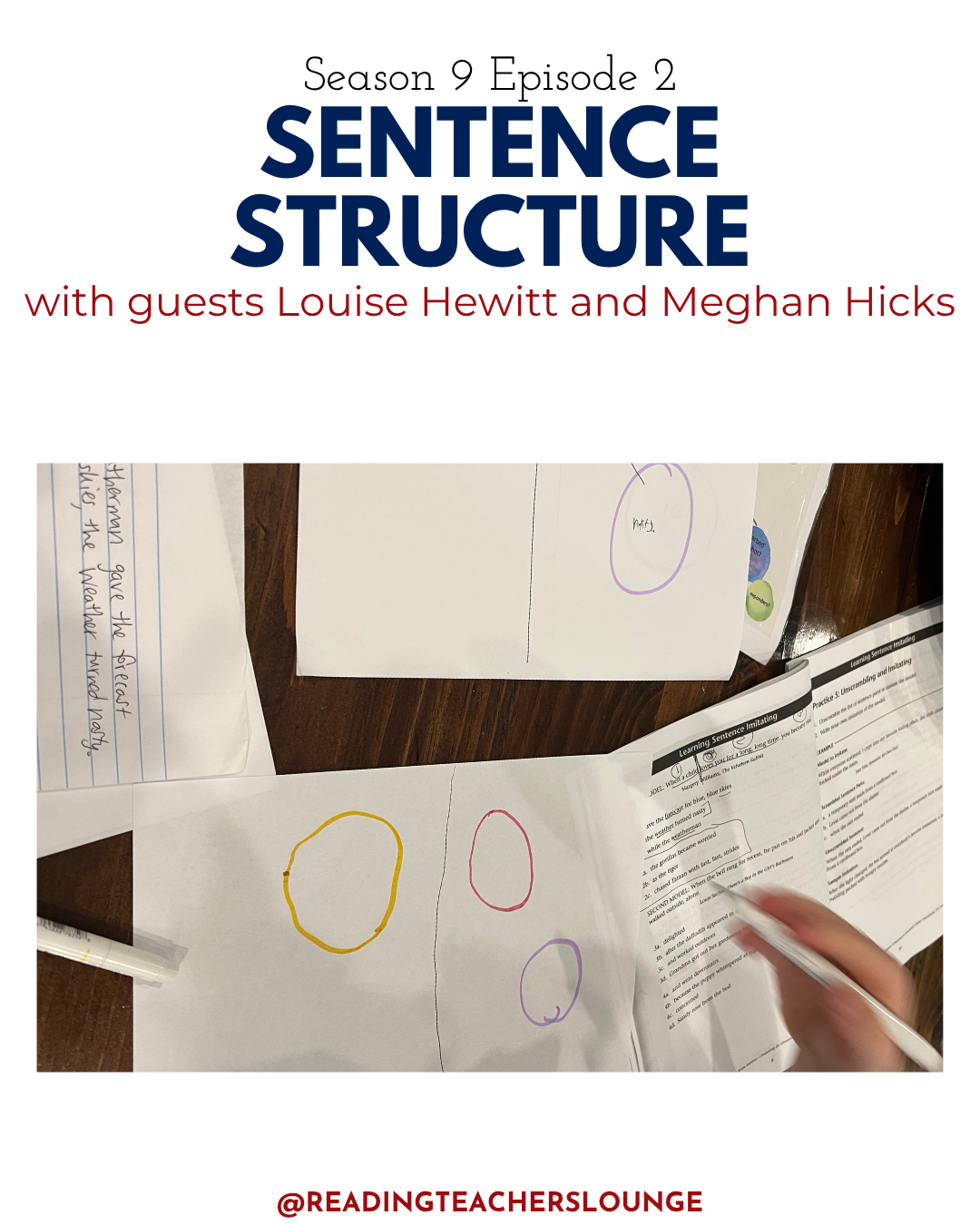
Yeah. And then that was also going too much into, like, part of speech and things like that. And so when I saw your bubble map [00:10:00] it just was like, oh my goodness, yes, I can use this tool. Because, and we'll show lots of pictures and, you know, and include examples in our show notes so that our re- our listeners can understand kind of the visual of what we're talking about.
But it's just so wonderful that first off when I introduced the bubble map I told the students, "Okay, the very first time you draw this you have to draw the line between the subject and the predicate, and you're gonna need to draw your yellow circle and your red circle because that's the building blocks of the sentence, because that's your who and that's your do."
And starting from the get-go with that, that's how the students start drawing the bubble. Like, they- ... they just draw those pieces, and then we build it from there.
Louise Hewitt: Yeah.
Shannon Betts: And I have one student she was very reluctant to do sentence composing but she loves Canva, the design program. Oh. And so the second I saw a bubble map and I attended your training I was like, oh my goodness, this is how I can get this student to like sentence composing- because she found some beautiful, like, watercolor circles that looked just like the [00:11:00] ones on y'all's bubble map example. Yeah, they were. Yeah. And she, like, she set up, like, a template with, like, all the different circles for the different you know, like, for the green ones which are the adverbs, and the blue ones which are the, you know, and the orange ones are the direct objects and things like that.
And she's got them all laid out so that then she can just, like, copy and paste it into, like, the new slide. But anyway, I think God, you said so many good things, Louise, but I think I just wanna ask, like, since you've added, you know, this bubble map and, like, these other resources, what have you noticed from your students?
'Cause that was the issue, right? That your students were struggling with- Yeah ... sentence level formations, sentence level comprehension. What have y'all noticed the transformation and the growth in y'all's students?
Louise Hewitt: Look, I mean- I know that most teachers come to syntax and grammar instruction with a lot of trepidation because they don't know it themselves.
Most of us didn't learn this at school. I had literally beyond verbs, nouns, and adjectives, I didn't know one end of grammar [00:12:00] from the other, and I worked really hard learning that and did lots of courses, and then I thought, "Okay, my kids can't write sentences." I'd done a whole bunch of work on text structures, and Meghan was super helpful with...
you know, 'cause like I said, I'm a kindy teacher. I don't write, you know, persuasive essays on a daily basis with four-year-olds. So kindy in Australia is America's preschool. So, you know, for me it was like, "Okay, I have to upskill really fast." I'm a great writer personally, but I've never had to teach writing.
So Meghan helped upskill me on all these different text structures and how to teach them, and so I went in, but I was still having no success. Kids were just-- It was all falling apart. So I thought, "I can't talk to them about their writing without a shared language." I have to be able to say, "Well, your sentence would be more powerful if you'd used a better adjective here," or, you know, your subject isn't clear in this sentence," or you've missed out a predicate," you know, "What's your s- what's your verb?"
And so I [00:13:00] launched on a really well-known one-year grammar program with all my students, and we every lesson did these. Here's this, this sentence, and you're going to mark the nouns and the verbs and the prepositions and the prepositional phrases and the who/which clauses and this and that, and they would do that with varying degrees of success.
And then at the end of a whole year of doing this, I would say, "Here's a sentence. What's the noun?" And they could not tell me. And then we would write, and it would be like, "Okay, here's your notes," and we've taken all the notes, and we'd summarize and blah, blah, blah, blah, blah. "Let's start writing. We've written our plan, you know.
Now let's start writing." How do I start? And I realized the whole point was these kids didn't know how to write a sentence. It wasn't that they didn't know how to put an introduction and a main idea and a supporting detail. They understood all of that. They'd done that ad nauseam. They still couldn't write a sentence.
So I felt like I'd was- [00:14:00] wasted a year of instructional time doing that, and really felt very awful about wasting so much valuable time. But it made Meg and I come together, and we said, "Look, something's gotta give here. We've gotta come up with another way." And that was when we started to play with the bubble maps and grouping things together, and what question is it answering?
Oh, it's answering where or when or why. And we started to do that informally with our students, and the difference was just transformative. They could identify what words were doing in sentences, and when they came to write, it would be like, "Okay, well, let's not just start writing with the subject and then the verb and then the predicate, and we end up with that same tired sounding sentence.
Let's map everything first. What are we gonna write about? What do you wanna say about them? Okay, can you tell me something about where or when or how?" And once they had all the elements, then it would be like, "Okay, well, how do you wanna start your sentence? Are you gonna start with the subject? [00:15:00] Do you wanna start with one of your expanders?
Do you wanna start with a when statement or a why statement? Because of the drought in, you know, South Africa, the population, you know, is relocating." There was all this flexibility, and they didn't have to invent it in their head. It was, they'd already done the work. It was just moving around pieces, and it was absolutely transformative, and it was suddenly they could do it.
They could, they could-- And I mean, yes, they still need support to build their vocabulary, 'cause that's another key part. But we knew that this had produced such a noticeable and immediate improvement that we had to formalize it into an instructional routine and so that was what we did with The Sentence Studio.
Shannon Betts: So you noticed immediate improvement in the production of their sentences. Did that translate as well into their reading comprehension and understanding, Yes ... what they read at the [00:16:00] sentence level?
Meghan Hicks: Yeah, absolutely it does. I think, you know, that for me is, Probably, there, there seems to be a an overall obsession with reading performance when you're thinking about literacy.
So children, Okay,
Shannon Betts: not just in America.
Meghan Hicks: No- Everywhere ... it is everywhere. It is everywhere. And sometimes it's just to the exclude- complete exclusion of writing skills as well, and I just feel like you, there, you get so much more bang for your buck as an educator when you're teaching writing because you're developing both sides of that literacy picture.
And for sure, the idea of being able to represent the, the meaning of a sentence visually is going to help kids to untangle complicated syntax. Yeah? Like- And- ... we we have we have... I actually wrote down a couple of sentences 'cause I wanted to talk to you about... Let me just see if I can find that sentence quickly.
Mary Saghafi: Oh, yeah. While you're finding that, I wonder it's [00:17:00] something that I've been talking about with other people lately, is this flip side of decoding and encoding, and we put such an emphasis on decoding. And encoding is not just spelling. It's really thinking about what you want to say, being able to have the phonemic skills to be able to put that on paper and actually write it out, and so that, th- this sort of resonates in that same vein.
And it's, again, something else that we're not talking about writing. We're kind of siloing reading skills and then writing skills- ... when really they can be the inverse of each other, and we need to really entangle them back together in order for kids to associate themselves as writers and as readers, i- in my opinion.
I've just been having that conversation lately. Meghan, please give us an example of the sentence that you were gonna use.
Meghan Hicks: So I was thinking about, like, you know, when we use simple sentences that have this predictable word order, then it's gonna be really easy to understand because you've got this one [00:18:00] main clause and then the action in the sentence is unfolding in the same order.
It corresponds with the word order, basically. So an example of a sentence, I wanted to think of a sentence that would illustrate that, and so this is what we came up with. During the water cycle, water evaporates from the oceans due to the heat of the sun, and then falls back to the Earth's surface as rain.
So you're reading... It's, that's not a, like a super simple sentence but you would read that word by word and the picture would unfold in your mind because the action of the sentence is corresponded k- really closely with the word order. But when you think about a sentence that has subordinate clauses, or if the subordinate clause is at the beginning of the sentence, or when you have multiple substructures that are kind of used to flesh out the big ideas in the sentence- Then the meaning of the sentence can often become obscured by all of those [00:19:00] words.
And so this is really what we're seeing, is that students who are able to decode but yet have poor reading comprehension, it's bec- the problem is syntax. The problem isn't decoding, and, you know, that's often what kind of stands stands out when we assess. But we really want people to think that there is another piece to this puzzle, and we think that piece is syntax.
So we've translated that really linear sentence into something that's a little bit more complicated, so you can see what those embedded clauses and things look like. So we've said, "As solar energy relentlessly heats the Earth's surface, liquid water from vast oceans evaporates into vapor, which rises high into the atmosphere where it cools, condenses into clouds, and eventually precipitates back to the ground as rain or snow, thereby replenishing the planet's vital freshwater resources [00:20:00] before the entire sequence begins all over again."
So same idea, but a completely different execution. And you know what? The kind of sentence that kids are gonna read in their textbooks- Yeah ... is the second sentence. It's not the first one.
Mary Saghafi: Right. It's the rigor that we're looking for our students, and it's the expectation to build knowledge at this high, rich literature le- level.
And so yeah, you can't just dull down the sentence into these, like, very minuscule things when this is where the expectation for our students' understanding comprehension. But I love how you said it's not just the decoding issue, it's a syntax issue. And I so appreciate that because I feel like Louise has-- how you had said is that teachers are often overwhelmed by the concept of syntax because we were not explicitly taught it.
We but this sentence example really clarifies [00:21:00] what is the syntax of a sentence and how do we describe it to students? I think that this is very this is an excellent example. Please continue. I am rapt.
Louise Hewitt: Well, can I just say, like, I think one of, one of the, the big issues and it's what you've just said, Mary, is that so often kids are labeled as struggling readers, but they might not be struggling with the reading at all.
They might be struggling with that syntax. And we kind of feel like there's a couple of common misconceptions that we see happening over and over again, which is, number one, people equate decoding with comprehension. "Oh, well, if you could decode the words, you clearly understood what was going on." Now, that's ignoring the fact that they may have less efficient vocabulary, so therefore they may not comprehend all of those words.
But also there's more to understanding a sentence or a text than just being able to successfully decode the words. The other problem is that people incorrectly [00:22:00] assume that reading quickly and fluently and with prosody, and maybe recalling some basic information about the text and responding to some question, also cr- correlates with comprehension.
Now, if you're a reader who can comprehend the syntax, by default you will perform well on all of those measures that are on our standard reading assessments. But the best decoding and the best fluency and prosody are not gonna guarantee that you comprehend that sentence. In fact, they may actually mask comprehension problems, particularly at that sentence level, because these kids read so beautifully and, you know, they pause in the right places, and they have expression.
And then when you say, "Well, what was that sentence about?" They're not really sure. They can't really tell you. So I think, you know, we do see a lot of common syntax challenges in struggling readers, but they're the same syntax problems we see in skilled readers. [00:23:00] So I think that's always really important to-
Mary Saghafi: I think you're-
Louise Hewitt: To be mindful of
Mary Saghafi: I think you're spot on with that. And something that I've noticed is as a teacher who works primarily with students with dyslexia, I'm often recommending audiobooks. And when I see a kid who's very resistant to audiobooks because that level is where the words are provided for them they-- it's read in a really well-done way there's character development and things that, that they should be a- attuned to.
If they find that frustration with that level, even though it's being given to them I do think that there is usually some language difficulties that we need to kind of investigate more. Because I see kids of variety and, you know, you meet one person with dyslexia, you meet one person with dyslexia.
Yes. However just because they are having those decoding issues as a primary- dyslexia issues. Sometimes with ADHD, there's some attention issues that kind of [00:24:00] fall into place. But if you can't really parse that out, then I often say there's underlying language issues. And dyslexia is a language-based learning disability, and so I think that's good.
So I think an indicator is, as a teacher who's doing a read-aloud that's a really rich read-aloud, if you're still noticing that those students are struggling with comprehension, it may be that they are having a language difficulty with it, which could possibly be syntax level. And I think that the way that we need to really dive into that is really leaning on our speech and language pathologists who can help us better understand if there are some underlying language difficulties.
I don't know how this is in Australia, but recently, especially in public schools in, I would say the last 15 years, they're really focusing on if students are having pronunciation issues articulation issues, and that is primarily what the SLPs are [00:25:00] focusing on in schools. They're often very overworked, and there's a lot of other things.
But tapping into the knowledge of an SLP as a general education teacher, they don't just live in their own home, in their closed office. You need to go and you need to seek them out and ask them, "What are some strategies that I can do in my own classroom?" And then also, thankfully for you all, you've also given us some strategies as well to lean on which is w- which is fantastic.
So I just thought I would share that audiobook thing, 'cause that's something that I s- I often say to parents. Please try to engage your kids with audiobooks. They can have the text provided for them, but if they're still struggling with that level, let's investigate a little bit more with the syntax level.
Shannon Betts: Well, I was noticing, like, myself and my own executive functioning when Meghan was saying that second sentence example, and I was trying to, like, kind of bubble map in my head, okay, like, what is the subject of this sentence? What is the actual order of the water [00:26:00] cycle and all the things happening with the evaporation and the sun and all that?
And if a student you know, has some neurodiversity and has some struggles with executive functioning, with working memory, and prioritization and things like that, they are gonna struggle even at that sentence level of just keeping track, especially if it is an audiobook. You know, Meghan was reading that to us like it was an audiobook, and if you can't quite prioritize all that in your head just at the sentence level, and then all of a sudden, like, the next sentence has come along, you know?
And you might have missed some really important points. And so I think it's important, like Meghan showed us with that ex- with those examples, like, pause as a teacher, as an instructional moment, and take a difficult sentence with the students and see how, where does the understanding lie and where does it break down.
And that gives you a lot of information just in sort of a short time with a isolated sort of work, you know, formative [00:27:00] assessment or whatever, to then know where to go from there.
Meghan Hicks: And you can't really do that- Thank you ... in a linear way. You can't do that in a word by word way. That's, that I think is what we've come to understand over this course of writing this book, is that you can't just look at a sentence word by word and analyze it for meaning, because that's not how our language works.
We have chunks of words that work together in groups, and they're related to each other in different ways. Some of them are main ideas, some of them are subordinate ideas, and we have words that signal that relationship.
Shannon Betts: Right, like the, you use the word thereby- Yeah ... and so you really need to understand that word and the words that come after it- Mm-hmm
and before it to fully understand the relationship between those sections.
Meghan Hicks: Absolutely. Conjunctions, I mean, conjunctions are so powerful for kids to understand, to be able to piece together what is the main idea, what are the less important ideas, or are these two equally important ideas? Do I have a compound sentence?
Even just being able to know what a [00:28:00] comma signals, you know? That is something. And, you know, you think about teaching commas as being fairly simple. Man the, the comma rules are not simple. They're not simple. They're really complex, and there are lots of reasons why you would use a comma in a sentence, so.
Louise Hewitt: But invariably, kids are taught, "Oh, it's where you need to take a breath." Well, no, it's not. Because you could have two words in a sentence and you could still have a comma separating them, so it's nothing to do with your diaphragm strength.
Shannon Betts: That's true. It's a comprehension thing, not a fluency thing.
It's a comprehension tool. So can you explain some of the, you know, resources that y'all have come up with to sort of help your students understand this? How do you where do you start with students with syntax, and then where do you, what's your, like, end goal in mind, and how do you get them from, you know, starting point to end goal?
Louise Hewitt: Yeah, I think the hardest thing for us when we came into this was there was [00:29:00] really no resources out there for us to use. There was no, you know, "Oh, what high impact strategies can you use?" Well, there aren't any kind of thing, you know? And we would talk to people, they'd be like, "Oh, well, no, there's really nothing at the sentence level kind of thing."
And so that was, you know, everything was either at the word level or at the whole text level. So, and that's not the point of breakdown for most students. The point of breakdown is at the sentence. So, you know, I think, you know, coming back to that whole, you know, that was where I'd gone through and said, "Okay, well, try teaching grammar.
That didn't work. What are we gonna do?" And then we came up with the Sentence Studio, and I think that there's a couple of really crucial things that we've come up with. You know, number one, and I think we've all kind of hinted on this, is they've gotta have authentic text structures. If you're gonna give the kid, you know, "The boy ran down the road on Friday," then that's what they're gonna give you back when they read, and that's the only when they write, and that's the only thing they're gonna comprehend when they're reading.
We [00:30:00] have to mix it up. We have to respect that kids are capable individuals, and if we show them how to approach a more complex text, they will be able to do that, and they can only write what they've read. Why do we have so many children who are poor writers? So often it correlates really consistently with the fact that they don't have a rich reading history.
They don't have, you know, bedtime stories. They haven't been read lots of different texts and different genres and different sentences. And so, you know, we really need to be, as teachers, you know, I think one of the saddest things about our modern-day society is that literary heritage that I refer to it as nursery rhymes and fairy tales, most of our children are bereft of that now.
You know, I say to kids, "Oh, you know, do you know, you know, Humpty Dumpty?" And they'll be like, "What?" It-- They just, they don't have that stuff anymore, and so they're missing rhyme, and they're [00:31:00] missing rhythm and unusual sentence, you know, word arrangements. So we need to be really mindful of providing a huge variety in the text structures and not being afraid of that complexity and that's very much what we've done in the Sentence Studio.
There are no really basic sentences. They're all, you know, very authentic sort of structures. I think the other really important strategy, you know, is functioning, s- switch-switching your function from, your focus from a- Focus on grammatical form and just the words to looking at the groups of words and how they're functioning.
So I mean, they're two really simple switches that you can make regardless of what you're doing. Better, better, more authentic text structures and start to look at bigger chunks rather than individual words. They would definitely be the most impactful things you can do. I mean, if you think of the word light Now that word could be an [00:32:00] adjective, like something, I have a, a light bag today.
It can be a noun, it can be the light in the roof. It can be a verb, it can be, "Can you light the candle?" You don't know what that word is. I mean, okay, let's have the best grammar program in the world label what that is. They could pick any one of those, and they would technically be right if they haven't looked at the words around it.
So that's where we're saying, if you don't look at the words around it, you can't know what the word is doing or how it's functioning, or even its form, because it's dependent on those surrounding elements. And I think that bubble mapping and the questions we ask are the two routines that we built into the Sentence Studio that are what give its power.
And it's... I mean, we were talking just prior to starting, Shannon, and you were saying, "Oh, but you know what? I don't think I'm doing it... I haven't done all the activities in the book. I've just been doing the map." And it's like, that's what we want you to do. We want you, once you've got your head [00:33:00] around, "These are the structures that I want the kids to focus on, and these are how I'm gonna draw their attention to it," do it in science.
Do it in maths. You don't have to do a single activity in our workbook. Once you've got those tools and those strategies, then that's a really powerful thing you have, that you can then bring syntax into your maths lessons and into your science lessons and into your history lessons, into any area of your curriculum whatsoever, because central to everything we do is comprehension, so that's really crucial, I think.
Shannon Betts: And then also, like, what's been helpful for my students is n- not seeing, is seeing that the function can happen at the phrase level and not just the word level, you know? So it could be- ... the adverb could be inside or it could be the phrase inside the closet, and they're both telling where, you know?
But sometimes it's hard for them to, until they see it in that bubble, to understand that phrase is acting like a where detail, which technically is [00:34:00] the function of an adverb.
Meghan Hicks: Yeah. And it is, and that's I think why looking at a linear sentence is not particularly helpful, because it is hard w- to see those structures as units.
And when you start bubble mapping and you can see those structures as units, it really illuminates that. It's like it stands out to kids. So suddenly now when I say to a s- a student, "Oh, that's a preposition, and this is a prepositional phrase," that actually has meaning. Whereas before, if I'd s- asked students to find those structures within sentences, that would've had no relevance to them at that point.
But I can build in the vocabulary of grammar or parts of speech, I can teach them that stuff now that I have a hook to make that information sticky. And I think as well that also goes down to the, like the word level, not only at the- sentence level, like we were talking about, you don't know what a word is doing until it's within the context of a sentence.
You can also [00:35:00] think about in terms of word study and morphology and functions of words. Those two things are so closely related, and you actually get to see that. So, you know, you can't learn anything in isolation. It's not really gonna be effective. You can-- And I, as much as I'm excited to see that people have finally realized how important morphological structure is for word knowledge you can have a little morphology party if you want, and you can build a matrix, and you can write a whole bunch of word sums.
But if you can't use that word in a sentence, and if you don't understand what job it's doing in that sentence, then why would you need to know what its structure is? Why would you need to be able to identify its morphemes if you don't know that those morphemes are contributing to the syntax, you know, o- of the sentence?
And if you don't understand that adding a suffix to a word [00:36:00] is going to change its grammatical function Within the sentence, then are you really teaching morphology as effectively as you could be? Because if all you're talking about is memorize the suffix and what it means, you know, we don't really talk about suffixes have, as having a meaning or prefixes.
They have a job. They have a, the-- So adding a suffix to a word changes the way that you can use that word within the sentence, within the context of a sentence. And-
Louise Hewitt: I think just- ...
Meghan Hicks: adding an I-O-N... Yeah. You got it, Louise. You-
Louise Hewitt: I was just gonna say, like, what you've said there, I think is so crucial, like at all levels of language.
We jump to form before we look at function. And the example you gave of the prepositional phrase just literally kind of made hair stand up on the back of my n- neck because when I did that year of grammar, the one thing not one child could tell me, which to me seems so obvious 'cause I'd done it with kindy kids so often, was prepositional phrases.
You [00:37:00] know, if I said, "You know, but where's the preposition? Where's the prepositional phrase?" You know, "Where's the thing that's telling me about the relationship, you know, between the noun?" None of them could find-- They would literally-- I ended up having to get to the point where they did everything else, look for what's left, that will be the prepositional phrase.
Now, because we don't necessarily call that a prepositional phrase at the start, we talk about the where expander. All of my kids know where the where expander is, and they can spot it, no problems. So now I can introduce the word, "That's a prepositional phrase." No one's saying you don't teach grammar at all, ever.
No one's saying grammar's not important. We're saying it's not the place to start because you're focused on too small an element and it's too nebulous, it's too obscure. Whereas if you can anchor it to something they know, "Oh, that's where. Oh, that phrase is telling me where. That's a where expander." And then once they're really good at that, then you add another layer.
Same with the [00:38:00] word structure. You can talk about, you know, it's a, a bound base and it's a free base, and it's a this, and it's a, you know. But if they don't actually understand what the word is doing and how it's functioning and why you would add an I-O-N to that word, and why you can't say I nomination tonight," why can't you say that?
Shannon Betts: Mm-hmm.
Louise Hewitt: Because I-O-N makes a noun, and you're saying something in the syntax of a verb. So- ... they're the things that kids have to know. You can't just teach them to spell a whole bunch of word and join things together like Lego, in the same way that we can't just thread words into a sentence like beads on a string, because- it doesn't always work
Meghan Hicks: Yeah and a number of times you hear people talking about ts- what an -ion suffix means. That is like the most nebulous idea ever, the -ion suffix, you know?
Shannon Betts: It doesn't mean- I know. I was trying to explain the -ness sub- suffix yesterday, and it's the same thing.
Meghan Hicks: [00:39:00] Yeah, because they don't really have a like a meaning as such.
They more have an action on the word, yeah? Mm-hmm. They change the way that the word functions. And I h- just recently had a a lesson with a student who were learning about the animal cell. That's our kind of knowledge component that we put in our lesson. And we were talking about the cell membrane being selectively permeable, and he didn't really understand what that meant, so we started looking at the words permeable and selectively to f- really figure out and dig deep into what that actually meant in terms of the animal cell.
And we looked at the structure of the word selectively, and we broke it down into the stem select, and then the I-V-E suffix, which made selective, and then the L-Y suffix, which made selectively, so we could see all of those parts. Then we wrote sentences with those words, select, selective, and selectively, and then we bubble mapped those sentences.[00:40:00]
And at that point, the student was ... It was, I could literally see the light bulb going off in, in his head, and he said, "Oh, when you add a suffix, it goes in a different bubble."
Shannon Betts: Oh, that's- kid-friendly language definition. That's exactly it. Wow.
Meghan Hicks: And that was really the crack. That was when I realized, oh, wow, I don't think I could have actually made that connection in better terminology than he had.
Mm-hmm. But it was just an absolute light bulb moment when he realized that the job of the suffix is to change which bubble it can go into. It's changing the function of the word.
Mary Saghafi: And so- And you're making the language that is invisible actually visible to them, and that structure, and I think that's what many of our stu- students are missing right now, so, agreed 100%.
You have to actually map it out. That's why we love graphic organizers in the first place, but you're making the visible in- the invisible [00:41:00] visible.
Louise Hewitt: Yeah. Yeah.
Shannon Betts: And I think, So, like permeable would be in a blue circle 'cause it could be an adjective, but permeability would have to be in one of those noun type of bubbles.
Yeah. Yeah ... I was asking earlier about end goal of this, of, you know, what syntactic knowledge you want the students to have, and I guess it's a similar goal that what Mary and I are working on with Sentence Composing is that we want students to be able to see a sentence- see it in meaningful phrase chunks, and then understand, like as if they could draw, like, little arrows.
Like, this phrase is modifying th- this main word in the sentence. Like, it's going back to the verb, or it's going back to the direct object, or it's going back to the subject, and this phrase is describing a detail about this part of the sentence. Is that sort of what the end goal is just for students to sort of somehow, if they have to do it on paper or if eventually they can do it in their mind, to understand where each part of the sentence is modifying other [00:42:00] parts?
Meghan Hicks: I, for me the, I did the, the time I, that I really realized how powerful a visual representation is, or a graphic representation of a sentence is when we were s- looking at a poem, and I just realized how many students are so intimidated by poetry because they-
Shannon Betts: Poetry comprehension is very difficult.
Meghan Hicks: Yeah. And, you know, that is really, that is the reason why syntax is hard at the... If you think about the syntax of poetry, it breaks all the rules because there are other more important rules that determine the structure of the sentence within the poem. And so we, you know, I have lots of students who are just allergic to the idea of poetry, and especially poetry analysis, and when I'm working with older students you know, you're working with pretty sort of complex ideas that you really have to think about how those ideas are relating to each other.
It is almost impossible to understand a poem if you aren't able to identify the main subject and predicate pair. [00:43:00] And so being able to bubble map a sentence, Louise actually just recently posted, she's been working on- ... a sonnet with one of her students, a Shakespearean sonnet, and posted on our Facebook page a glimpse into a lesson using the Sentence Studio, and showed how bubble mapping that Sonnet 81 actually made the meaning clear.
The student went from saying, "This is completely incomprehensible," to, "Oh, I actually understand what this is about." And that didn't come about through any lengthy explanation.
Shannon Betts: I think I might need to bubble map the sonnets myself.
Louise Hewitt: Yeah. Well, yeah, it's, Shakespeare is hard going, even for adults. But, you know, she sat there, and I just took her through it.
I go, "Well, look through it. What's your subject gonna be? And what's your predicate gonna be? All right. What are, what other things can, what questions can you see being answered here? You know, what might, what, this group of words, what might that be answering? Would it be telling you [00:44:00] where, or when, or why, or how?"
And then she gradually just built out from there until she had this map of the first, you know, four lines of the, the sonnet done in no, no time, and it made perfect sense. It was- you know, transparent where at first it had been totally opaque to her, the meaning Mm-hmm.
Shannon Betts: That is so cool. And I guess it goes without saying, but, like, once you have that beautiful, like, map and understanding of it, then to do a reread, you know, as a fluent reader- Yeah
with that understanding, and then you can really un- you know appreciate the creative, you know, flow of the language that Shakespeare chose- ... I think w- is important, right? To do that reread after you have that full understanding of what the sentence is meaning.
Louise Hewitt: Yeah.
Meghan Hicks: And I think- And you know, you often talk that when people talk about Shakespeare, they talk about [00:45:00] iambic pentameter and how that was the driving force behind his structure, and I just think that is pretty meaningless if you don't even understand what the words are trying to tell you.
If you come into that poem with that sonnet with actual comprehension, then you can really appreciate how skillful he was, because being able to write a poem that conforms to very specific rhythmic confines or boundaries, as well as communicate the meaning that you intend, that is a, a very skillful writer writing process.
And it's, you know, it really gave me a much greater appreciation for the genius that he really was, and I think that most students probably would not come away from Shakespearean studies with that kind of appreciation
Shannon Betts: because- Right. Well, there are a bunch of layers of figurative language in there too, right?[00:46:00]
Meghan Hicks: Yeah. Yeah.
Louise Hewitt: And
Shannon Betts: I think that- Personification, simile, metaphor, every-
Meghan Hicks: Yeah.
Louise Hewitt: I think in our literature classes, I don't know what it's like in the States, but I know there's a, a big pushback from students. "Oh, you know, we don't wanna read that old stuff. We don't wanna read Dickens. We don't wanna read Hardy. We don't wanna read, you know, Thoreau," or whatever it is.
And I used to think it was 'cause, you know, they couldn't see the relevance, but those stories are timeless in their themes. You know, those ... it's human frailty and it's, you know, envy and greed and love of country, and all those. They're timeless themes. The problem is they don't understand the syntax.
And then there we are, we're back there again. Even at the high school level, even with adults reading books, they will avoid certain forms of literature, not because it's not relevant. They think it's old-fashioned and it's this, but it's really just the structure is so-
Shannon Betts: It's not straightforward syntax.
Yeah. Those older [00:47:00] writers used more creative- Yeah ... syntactic structures.
Louise Hewitt: Yeah.
Mary Saghafi: So interesting too, because we have so much at our fingertips. But you know, as we often talk about political-ness or however you, your algorithm really determines what you are hearing, seeing and consuming. If your algorithm is very basic and only in the same type of sentence structure or you know, common language, sometimes it's slang for some of my students, and so, you know, we all have our own individual one.
But if that's the bubble that you are in I think our job as teachers, especially of teachers of older students, is to really help them push beyond those boundaries and help them feel capable of reaching it. And I do think that there is this whole sense of I don't know how to start that, so I'm not going to start it because I have so many other distracting things that can focus my attention in a different [00:48:00] direction.
I think we have to teach ourselves and our students to really fight against that and really challenge ourselves to see, okay, what is missing? So, I, I really appreciate the fact that you noticed that there were not the resources at your hands. We have to kind of develop our own resources and chart a path so that others can take this invisible task, make it more visible for our students.
But I do think that there are so many layers within that, and AI also is going to complicate that as it's using a very specific rhythm of speech that, that mimics human behavior. But I think it's mimicking it in a way that is also very straightforward syntax because it's easy to read. So I think that's a really interesting just twist on what's happening in the real world right now.
Louise Hewitt: Very much so. And I think that's a really interesting point because Meghan and I will sometimes, you know, ask, you know, things about word study or about grammar or anything, and we'll check things on AI just like, "Okay, well, let's just see what [00:49:00] answer we get back here." And for a long time I re- worked out that Meghan and I would get back very different responses, and it was because of the way we were wording our questions.
Interesting. So even the syntax that you put into an AI, you know, like ChatGPT, depending on the complexity of the way you express that question, very much influences the quality and depth and rigor of the answer it spits back. Because I used to think, "Why does Meghan get this stuff and I don't?" And it was because I'm not a tech person.
I don't like tech. I'm a bit of a ... I'd be happy living on a little Amish farm somewhere probably. But like, I would just go in and just ask the question and I'd be like, "Well, how does Meghan get all this great stuff?" And then I realized it was because of the way I was ... I couldn't ... I was just assuming it would read my mind or something.
I don't know. You've ... You're only ... You put in garbage, you're gonna get garbage out, basically. So she
Shannon Betts: was putting more dependent clauses in there- Yeah, she was putting way more- ... and giving AI more information.
Louise Hewitt: Yeah.
Meghan Hicks: I [00:50:00] also spend more time, I spend more time arguing with ChatGPT. When it gets it wrong, I tell it that it's wrong.
I will just ... I do ... On that note of,
Shannon Betts: And it'll say, "Good point. Thank you for pointing that out."
Meghan Hicks: Yeah. Yeah. On the AL- on the AI topic, I will just say that, It's concerning the number of sentences and worksheets and stories that are generated by AI and are fed to children as standard educational fare.
And I feel like the temptation to do that as an educator when you're pressed for time is really strong. So I want to reassure everybody that the sentences that we've provided in our instructional units, which is like the kind of free workbook that we send people when they purchase the book, that that they are not written by AI.
They are written by us, real people- Mm-hmm ... real teachers, and they are written in response to the kinds of errors that our students consistently make. So we had a long piloting period where we had lots of different educators from all [00:51:00] different walks of life trying trying our stuff out with stu- with their students.
And you know, we really thought- think very long and hard. Every sentence that goes into the book is something that we have considered and chosen and crafted with a particular goal in mind. And you know, the scope and sequence of our material that we've created is is not random. It's something that's come about as the result of a long period of trial and error, and probably more error than we would have liked, but we got there in the end, I think.
And- ... you know, I, it's... You have such a diverse-- I have a very diverse student body. I have students who are incredibly bright and need lots of extension, and then I have students who just have spent their entire lives struggling and can never really get on top of that, what feels like a race to them.
And this is the first time that I've really had kids, [00:52:00] even kids who are, like, second language learners you know, that is just an amazing thing to see, that it's very difficult. Like, I speak a second language, but it's not a second language that lots of people in Australia speak because I was born in Africa.
And so, my second language is not useful to most of the students that I teach. But it has given me a perspective on what it's like to learn another language. And let's face it, English is not the easiest language to learn, yeah? It's not a transparent language. It hasn't, doesn't have a transparent orthography.
And interestingly, although a lot of our words come from Latin and Greek, our syntax is Germanic.
Shannon Betts: Mm-hmm.
Meghan Hicks: So it, you know, it's this real hodgepodge of influences. I think that makes it really challenging for for second language learners. And- If you think about people who learn English as a [00:53:00] second language, adults, every adult that I've ever come across who speaks another language as their mother tongue has really great grammar knowledge because that's how they learn English.
That's the doorway into English is through through grammar and syntax. So how much easier would it be if we could make that visible for our second language learners as well? I feel like that's a really powerful argument for not treating sentences in a linear fashion, and not thinking about word order, and thinking more about what are the larger structures within the sentence and how are they related to each other.
Shannon Betts: Going back to what you were-
Meghan Hicks: Because, you know, like, the subject of a sentence is the subject of the sentence. It doesn't matter if you're speaking English or French or Japanese.
Shannon Betts: Truth. Truth. Well, going back to what you were saying about, you know, like, worksheets versus, you know, richer activities, when I've been justifying [00:54:00] doing the sentence level work, you know, with the parents of my tutoring students, I'm showing them, and I s- I say the phrase every time, I'm like, "Well, you're getting so much learning, you know, for the activity buck."
Like, I'm saying, you know, i- in just this 20-minute activity where we're kind of, you know, analyzing these sentences and, you know, composing other sentences and combining sentences, I'm like, "We are working on vocabulary. We are working on grammar. We are working on comprehension. We are working on so many things at one time."
And that is really valuable to look at as a teacher, as, you know, okay, I could give the students a, a worksheet and they underline the nouns and circle the verbs. Okay, what is that really gonna transfer to as opposed to 20 minutes of doing something like this?
Meghan Hicks: And that integration.
Shannon Betts: Yeah. That's when you- And it's fun actually
it's when you bring it
Meghan Hicks: all together.
Shannon Betts: It's actually really fun once you bring in the bubbles. Like, it's like a problem-solving thing. I don't know. I love puzzles, so that's what it feels like to me is where does this part of the sentence go in which bubble and [00:55:00] things like that. Yeah.
Louise Hewitt: I think if you're always looking at grammar as a separate subject, "Oh, now's grammar time, now's vocab time," then they don't actually understand that it is this tool to help them to comprehend complicated sentences and to write complex sentences.
You know, if it's just something that is just fill in the blank and drop in the word sort of Mad Libs style, well, where's the value or utility in that? Like, why would you invest valuable, you know, thought into that if you can't even see a purpose for it? Whereas when you're looking at the whole thing and the structures and, okay, well, how could we change the expander?
You know, could you put in, you know, a different where expander? You know, how could you direct-- change the direct object? You know, all of those things that you can substitute elements. They then realize how flexible a sentence is and how easy it is to manipulate those elements to make a way more [00:56:00] interesting sentence.
And I think for a lot of kids, they go with those basic words, you know, "The man walked down the street," and it's like, it's going to that, well, how do we create a really rich image in our reader's head? Because- I mean, I think if your definition of reading is simply that you spit out words, you've kind of missed the point.
The definition of reading is, number one, comprehending, and the definition of writing is being able to put what's in my head into your head- Mm-hmm ... in as complete and rich and magical way as we possibly can. And if you're not getting beyond the boy walked down the road, you know... I sat with a child today and we're looking at Fat Bear Week in Katmai National Park because I just desperately wanna go there.
Shannon Betts: And- Oh, my husband is obsessed with Fat Bear Week.
Louise Hewitt: Oh, God. I just love it so much. So she started-
Shannon Betts: Got the brackets and everything.
Louise Hewitt: She started with, you know, the bear, you know, ate, [00:57:00] or caught fish, you know, in, in the river. And I said, "Well, look at that bear. What is he? Oh, the starving bear. Oh, you can see his bones.
What kind of bear might it be? Oh, the emaciated bear." You know, we got to that, and I had to give her the word emaciated because it's part of vocab building. We're doing it all at once, you know. And then I said, "Emaciated, what do you think the structure of that word is? That's really unusual." "Oh, well, I can see an E-D.
I can see an A-T-E." You know, or maybe, you know, so we play with those things. "Oh, that's interesting. We should come back to that." You know? We've got some theories that E might be an X, you know, an assimilated prefix. "Oh, it could be. The M-A-C-E might be the base." All right. We don't have to go and do a deep dive on that word.
We're just touching in. And then, you know, okay, caught, you know, what's a word? Oh, and she came up with, you know, scrounged for or something. And then, you know, "Oh, well, what could we say about fish?" "Oh, what kind of fish?" "Salmon." "All right. Well, what could we say about s- you know, glittering, you know, red salmon kind of thing."
You know, and just [00:58:00] building that up so that every time we're just laying another layer to that picture in the reader's mind of what's happening so that it's like they're standing there. And we can- This is- ... only do that if we can tune them into those individual elements that they need to fine-tune
Mary Saghafi: I, I was gonna say, this is such an excellent example of tuning into what a writer's conference really should look like.
And I remember especially when I first started teaching my writer's conferences were so, exhausting because it was me providing words for the students and actually transforming their own language rather than helping them to develop this self-talk that you were just describing. How do I question the words?
How do I make this word richer? So I think that this is, that's like a, a perfect example of how we are developing what a, a real writer's conference can sound like once you give students the language so that they can develop self-talk, and they [00:59:00] can modify their writing and their language. So, fantastic description there.
Louise Hewitt: And I think one thing that Meghan always says, and I just agree totally, is when you're doing that, that editing and that refining, you wanna do it at the point of writing. You don't wanna write the whole thing and then say, "Okay, now let's do it all again. That was great. It's not good enough. Start all over again."
Like, just edit as you're going. "Oh, I love that sentence, but, you know, I'm really just not getting an idea of, you know, the water. What was the water like? You know, the cold, bubbling water," whatever, you know. Could you just... And it doesn't have to be fix every single bubble. It could be let's just really get amazing predicates here.
We're gonna get the richest predicate verb. So instead of walked, you know, he traipsed, or he staggered, or he... Let's just really focus on that. And another day you can focus on something else. It doesn't have to be this everything has to be, but it's that modeling of that self-talk. And I think, you know, even if you don't use all the Sen- Sentence [01:00:00] Studio, that is giving you that self-talk of, "Oh, what am I saying about where?
Oh, you know, who, you know, the, the boy kicked what? I need a direct object." So it's getting that pattern of how do I approach this task of writing? What are the elements I'll need in here? And then building those ways of refining those things. Yeah.
Meghan Hicks: I think as well, students don't have those questions at their fingertips.
So that is why we've got kind of two parts to the instructional routine. We've got the bubble map, but we've also got the questions we ask. And initially, we ask those questions as the educator, but eventually, those questions are not even something that the student needs to read anymore because they can just generate them for themselves.
And when you can generate those questions, that leads you through the process of sentence analysis when you're reading, and it leads you through the process of sentence synthesis when you're writing because the questions are what drive the syntax of the [01:01:00] sentence. So, you know, we really want to, Kids- Kind of like training wheels
I it's, it is. It is exactly like training wheels. You start out with this kind of routine that is very consistent and repetitive and stays the same throughout, you know, the entire student workbook that we've created. But at the end of the day, like you s- show, Shannon, you know, when you are bubble mapping a sentence that is related to something, you know, just what- whatever it is that you're learning about at that time, that is rooted in so much meaning for the child because it's related to the stuff that they're learning about.
And they can see how asking those questions helps them to write a really good sentence. There is nothing more motivating for the student than that. For, for a sentence that they can read out, that they've written, that they know solidly represents the idea that they had in their head. That, that is, you know, if you [01:02:00] just wanna just nail one good thing in your lesson that you come away with, it's that.
It's that feeling for students. It's so motivating. So motivating.
Mary Saghafi: Meghan, I could not agree more. When we were talking about how y- you know, if you were to do every single sentence with your student while you're talking about this, I am immediately m- imagining my student's head on the desk, just exhausted because they don't know how to complete that level of work.
Or if you are guiding them every single step, then they're frustrated because they're not doing it themselves. And then Meghan, you are 100% right. Once you t- are able to allow them to do it independently and they feel that success, that is the end goal truly, and then they will be so motivated intrinsically to want to do that again and again.
And I think that is the goal of actually teaching is really helping that student to do the skill [01:03:00] independently. So, I think that's an excellent description, too.
Louise Hewitt: Well, the struct- the instructional s- series of questions that we ask that is in the Sentence Studio, we've a- actually designed it in a way that every subsequent question is worded so that contains the answer to the previous question.
So, it's a self-checking mechanism. So, if it's, you know, "What's the predicate verb?" And the predicate verb was ran, the next question will be, "Who or what ran?" So, you know you got the bubble right because it's got it there in bold print that ran is the word you should have picked. And then, you know, who or what ran might be, oh- the, the boy, the next question will be, "The boy ran where?"
And that's your expander that you've gotta find. So you've got the answer there, the boy. So you can always, kids can always self-check, which means they can work independently for those kids who don't want, you know, us hovering and doing it all for them. But it's building that self-talk. They're getting that...
Because they're verbalizing it and can read through it [01:04:00] themselves, they're getting that instructional routine just embedded that they don't even need the questions anymore. They know what to tune in for and what to look for.
Meghan Hicks: And some of the people who trialed who piloted the program for us were people who were really nervous, educators who were really nervous because they said, "I know nothing about grammar.
How am I going to teach my student?" And, you know, it's just amazing that they work through this program alongside their their student, and they come out knowing things that they didn't think they would never really understand. Like, you know, for the longest time I struggled with remembering transitive, the difference between transitive and intransitive verbs, and it was only after we, after I bubble mapped them that I was like, "Oh.
Oh, that's so obvious. How did I find that hard before?" You know, it's just something so, so,
Shannon Betts: you know, something- Transitive ones have direct objects, correct?
Meghan Hicks: Yes. The transitive verbs have a direct object [01:05:00] bubble, and if they're intransitive, there is no direct object bubble, and that just completely changes the way the bubble map looks.
It's a very obvious difference. And, you know, interestingly as well with going back briefly to second language learners, I've just-- I've got a French-speaking student and he was r- we were talking about bubble mapping in English, and then he just said, "Oh, I wonder if I could bubble map that in French," and tried bubble mapping in French.
And then he was like, "Oh. Oh, that's so interesting," because the sentence, the word order in French versus English is completely different But the word order in the b- or the way that the bubble map looks is exactly the same. The same words are in the bubbles. And he w- and he was close-
Shannon Betts: Because it's still modifying the other parts, right?
Meghan Hicks: Yeah ... because it's about the ideas, and that's really what language is. It's about the ideas that we're trying to communicate, and so often we boil it [01:06:00] down to just the words, and it's really not just the words, it's the ideas behind the words. When you're thinking about what to write as a writer, you don't start with words, you start with ideas.
And you've got to transl- translate those ideas into words, and then you've got to be able to put those words into a written form that communicates your intent. And that is such a multifaceted process. I think we often, you know, the things like the reading rope and the writing rope, they have really kind of pulled apart those very complex, dense processes and helped us to understand all of the underlying skills.
But it's just as you said, Mary, we now have to twist those things back together again so that we can really see. It's all very well to understand the component parts of the process, but the process is holistic. The process is a whole process.
Shannon Betts: And so- And we're asking the students to apply it. They are doing it all twisted together.[01:07:00]
Meghan Hicks: Exactly. Exactly. Yeah. Yeah.
Louise Hewitt: And I think the other really excellent thing about using the bubble map is that for those kids who really do struggle with expressing their sentences, you can either get the little magnet circles, which we have magnetic bubbles that you can manipulate, but also I just say to kids, "Okay, you've drawn that.
Put each bubble on a Post-It note, just a scrap of paper. Now, work out how you're gonna put your sentence together." And they can just move the bits around. They're just chunks. Rather than looking at a big, long sentence and saying, "Oh, what doesn't sound right, and what needs to be moved," and you know, s- arrows and
Just move the things, and then once you've got it right, write out your sentence. You've got it sitting there
Shannon Betts: Oh, I wanna try that. I wanna try that with the sticky notes. That's fun
Louise Hewitt: Yeah. No, it's, If you don't have bubble map makers, just use sticky notes. It's a great way. And particularly, I've been talking to my kids a lot recently about when we make a bubble map, you know, you've got your subject [01:08:00] on one side, and maybe you've got a couple of describers, but a lot of that meaty stuff is on the predicate side.
You know, it's really weighed down with your expanders, your direct objects, your subject complements, your indirect objects. But that doesn't mean we have to write our sentence like that. We wanna aim for, like, a balanced scale. We wanna create weight on both sides. So one of the first things that we can move to the start of that sentence very easily and effectively is our when expander and our where expander.
So in Katmai National Park, every spring, bears gather to feed on salmon, you know, for nutrition. And that way it's easier to read, it's easier for our reader to comprehend what we've written than bears gather in Katmai Park to do this on this day, at this time. You know, it's just too much. It's too heavy.
So when they can move things around and experiment with that, they start to internalize [01:09:00] that, you know, that feeling of what sounds right, what doesn't, what sounds jarring. Why does it sound jarring? Oh, because we've got the word, you know, there, you know-
they're fishing diligently, but you've said they're fishing in the water diligently, and it's oh, maybe that should be closer. Maybe it would sound better. Maybe we could swap those two elements, and it's easily done, and they can compare the sounds and start to build a really internal appreciation for what makes good English syntax, what makes a really interesting sentence for our reader.
Shannon Betts: And then just naturally, because they've gone through that- ... writing process themselves, they immediately apply that knowledge to when they're reading other writers' sentences.
Louise Hewitt: And it's empowering. It's like you said, Mary, it's really hard to say, "Oh, well, I know that sounds bad, but how do I tell them what to fix, and how [01:10:00] do I point out," you know, without literally...
And that's where I was before we came up with this process. It was like my only option is to say, "Let me show you how to do it," and I'll rewrite the sentence. Wouldn't it sound better if you put this here, and wouldn't it sound better if you put that? And by the end of it, it's not their sentence anymore, it's my sentence.
By just giving them little chunks, they can easily see how to tweak those because it's not this overwhelming big line of text, it's just this one little element. What could you tell... Could you tell me more about that? Just a prompting question like, "What else could you tell me about how he went?" They can sort that out.
It may not still be as finessed as you would do it, but it's gonna be a big improvement, and they've got agency, and they've got ownership. And if, you know, these kids are struggling, and they're probably struggling not just with syntax, but with a whole lot of other things, every win they get is just... It's just success breeds success.
If we can give them something that, [01:11:00] you know, you're using the colors on them, Shannon. I personally don't use the colors, but you can if your kid needs that. It's a great scaffold for them to be able to remember which bubbles are which. Anything we can do that gives them that little bit more agency, that little bit more feeling of, "Yeah, okay, I, I get what's going on here.
I can do this. It seems manageable," rather than just, "Oh, she wants to know where the noun is, and I've got no idea, and I'm just gonna have to guess, and I'm just gonna throw it like spaghetti on a wall until something sticks, or until I see..." You know how they do it with teachers, and they can see your eyes or your mouth move a particular way.
They're really good at reading your body language, and they know whether they're about to tell you the right thing. Like, it shouldn't be a guessing game, so we really need to give them those tools that, that will enable them to be successful.
Mary Saghafi: When you said guessing game it's the, that's most cringing teacher thing.
Well, because that's- Yeah ... that sounds right, or that's just the way we say it, or... and it's because we don't have the answer that we- Yeah ... we say [01:12:00] this, so I'm... Yeah, perfect.
Shannon Betts: And I wanted to ask, like, what, you know, while we have you on air, and I we could talk to you guys for hours, but what kind of tools do you want s- teachers to try with the students to help them, you know, understand things more at the sentence level?
Meghan Hicks: I think the, like the big ta- big piece of advice that I would give if anybody was really thinking about how to really dig into syntax with their students is stop thinking about individual words. Yeah, so shift your focus from individual words-
Shannon Betts: Stop labeling parts of speech. Stop having the students- Yeah
label parts of speech.
Meghan Hicks: Yeah. Shift your focus to groups of words.
Shannon Betts: At least for beginners,
Meghan Hicks: for a start. Yeah. Think about how those think about what those, what job those structures are doing. Don't focus on what the structures are called, focus about what job they're doing. And you can think about you know, or in terms of wh- when you're thinking about what job the, or the function of a [01:13:00] structure, you really you're facilitating reading comprehension, you're suppo- supporting written expression, you're helping students to understand how to build more complex sentences, more interesting sentences, and- I think, I believe, and I think Louise probably agrees with me as well when I was focusing on form, on grammatical form, I really felt like I had to be the expert because there is a right and a wrong.
Yeah? And so you had to have a lot of, I, I had to have a lot of expert knowledge, and I just didn't feel like I really had that knowledge, and sometimes I really felt like I was flying blind. And since we've shifted our focus and we're really thinking about, it's, there's just so much more playfulness and the ability to to justify your perspective.
You know, you have a s- you have a perspective on what a sentence should be and what a sentence looks like and what the structures are in that sentence, and you can justify your position. It's far more scholarly to behave in that way, I think, as [01:14:00] an educator, not presenting yourself as the fountain of all knowledge, but, you know, just you have space to learn alongside your students.
It's more intuitive. You don't have to know everything upfront. And so that's, I think, the beauty of fo- you know, shifting your focus like that, is that you just have time. You give yourself some time to learn the things that you need to learn. And, you know, as teachers, we're so busy. We're so busy. We're, our jobs are really quite pressured, and we have a lot of responsibility.
So giving yourself some grace and some space to figure out what's important in the sentence and how to teach that and communicate that with your students, I think grammatical function really does that in a much better way than-
Shannon Betts: Yeah ... than form. If we teach everything in isolation, we don't have enough time to teach it
Meghan Hicks: all.
No.
Shannon Betts: But if we teach it layered together and we slow it down like this- Yeah. And syntax isn't- ... then it's, then the time becomes, like, you know, honestly [01:15:00] more expansive.
Louise Hewitt: Syntax isn't like a literacy block thing. It's how do you make sense of a math problem? How do you understand, you know, the sequence of events in a historical text?
It's like it's, it should be everywhere. So I think if you're limiting syntax instruction to, you know, a, a 40-minute or one-hour l- literacy block, you're really cutting off your nose to spite your face because you could be getting so much more out of it. One thing I just also wanna mention that just came to me is- I think once you approach this, you will be surprised at the discoveries your children can make because I was sitting with one of my little grade three students today, and one of the sentences that we were working on was the milkmaid would sell, All the pats of butter at the market, and it was direct object lesson.
And so she'd put all the pats of butter in her direct object circle, and I saw her hesitate, and I said, "Well, what [01:16:00] are you thinking?" She's like, "I don't know whether at the market should go there." And I said, "Okay, well talk me through that." And then she said, "I don't think it does, because if it was sell all the pats of mar- butter at the market, it would be that she would be selling everybody's butter, not just hers.
It would be like all the butter at the market. So I think at the market is telling me where she would be selling all of her butter." Now, I mean, where would you have got that understanding out of let's read a line of text? You just wouldn't. But because she knew there was this other bubble that was a possibility, and she was weighing her options, she was able to go through the connections, and that's what we talked about, the connections between the related ideas and say, "Oh no, that's not the idea we're getting here.
It's this other idea, and I have to map it differently." But she was aware that if she'd put it all in one butter-- bubble, in the direct object bubble, that was quite acceptable. It just meant something different. So it's it [01:17:00] really is powerful when you start to think about the big questions and the big structures rather than just this word follows this word.
We're so repetitive. We just keep harping on a tone here, big structures
Mary Saghafi: Because you need to and we need to hear it as listeners too. I think that the advice is so great, and it's the one thing that we're really trying to do is that we have this really great understanding of the science of reading as opposed to how I maybe did not understand it when I was first going through school and college and things like that.
So now we understand all these pieces, but we need to understand how to put it together. And so I think that these examples of focusing on the function, focusing on the self-talk and asking the questions, that's where the rubber really meets the road. So I think that you both are right and that's the advice to give just to start.
And I think we've talked about this with morphology. It gets a [01:18:00] little messy because we don't feel con- we as teachers don't feel confident, and the language feels like there's lots of vocabulary words that I'm not very familiar with. They're describing words. I'm used to just giving the, the answer to the student, or I'm used to, you know, giving the phrase and letting them ex- use that as the example.
So I think part of it is really just being brave and diving in and being vulnerable with your students to find the answer together. And I think there's actually a lot of grace in a classroom when you do that. And so being brave enough to start that is, is maybe another tip that I'm kind of hearing through our conversation.
Shannon Betts: And I'm thinking of other bubbles. I'm thinking of the Simple View of Reading as we're talking about this, and it really is like making active that second circle of the Simple View of Reading, of that language comprehension. Like, you were working, Louise, with that student to fully understand what the milkmaid was [01:19:00] doing with her pats of butter- Mm-hmm
and that is what kind of formed for that student, that full reading comprehension piece- Mm-hmm ... working on it together. I love that. Mm-hmm. So the bubble map is a tool to really facilitate that language comprehension.
Louise Hewitt: Mm-hmm. I mean, another example the other day, we had the rooster's crow woke somebody, and I ha- I said to Meghan, "Have you noticed this?"
'Cause I've now had a couple of my kids say- The rooster has a crow? Did the crow wake the person? And I'm like-
Shannon Betts: Oh, they thought it was- Oh ... the black bird. They thought it was the black bird. Yeah. Okay.
Louise Heweitt: Like, the, the rooster owns a crow, and the crow's going around waking everybody up. I'm like, "Oh, okay, there's a big...
Okay, there's a vocab word here we don't have." They don't know that cock-a-doodle-doo is referred to as the rooster's crow. So they were thinking there were two birds, and this is what I can't... From the very start, remember we started talking about what are the misconceptions? Well, if your student thinks that the rooster [01:20:00] owns a crow because they don't know what the word crow means in terms of the noise a rooster makes, they're not gonna answer your comprehension questions probably, and it isn't 'cause they have a reading p- problem or a, a decoding problem, it's 'cause they have a syntax and a vocab problem, and syntax and vocab, my goodness, those things are just crucially dependent on one another.
So we've really gotta be building both at the same time, and how do you do that? Through authentic texts, through rich vocabulary and sentences
Mary Saghafi: I have thoroughly enjoyed this discussion today. It's really opened my eyes and made me really reconsider some of the practices that I'm doing as well. And Shannon had shared with me prior to meeting with you all, you gu- you're just gonna absolutely adore these two ladies. I think that their product is fantastic, and you're gonna just love it, and she's 100% right, as she usually is.
And I really love that it seems [01:21:00] like you both have sort of a similar relationship like Shannon and I do, where we are so excited to share these wins and some of these, like, questions and things that are going on with our students, and i- it's just authentic. And you know, I... It's like the virtual person who you can go over and knock on the door across the hallway and say h- how is this working for you?"
Or, "You won't believe what happened today." And I think that's a huge part of the joy of teaching is really sharing, learning, and growing from professionals. So I just wanted to thank you for your time and for your effort on this amazing resource for teachers. We're so happy to have you, and we would love to have you back as well because I think it, it's a great ongoing conversation and it has lots of layers to it.
Meghan Hicks: We're working on volume two, so when- Oh ... volume two's done, we can come back.
Shannon Betts: Exciting.
Meghan Hicks: I didn't tell you about that.
Shannon Betts: Exciting. We have the time constraints between our time zones, and we will figure it out because we want to talk to you guys again.
Louise Hewitt: Love to come back [01:22:00] anytime.
Mary Saghafi: Absolutely.
Louise Hewitt: I had one more thing.
Shannon Betts: Yeah. Yeah, please.
Louise Hewitt: I just know that teachers are so drowning in assessments, and, you know, this lockstep, w- we spend more time being accountable and ticking boxes for administrators than we do teaching half the time. One thing that's really important is when you bring on this approach- The assessment's done.
There's no additional assessment to do because when they bubble something incorrectly, you know they don't know what a subject is. So you know that's what you work on next time. When they, you know, combine two elements, you know that they haven't worked out w- which expander that... Like, so, you know, there's loads of games and things on our website that are like, okay, they read a sentence, "Okay, tell me what the where expander is in that sentence.
Move forward to the where expander on the board." It's play, but it's all assessment data. Like, that is my assessment. So this, you don't need a worksheet. You don't need to print something off and give it all to them. You can just put up a sentence and everybody can be [01:23:00] mapping it, or they can be writing a story and map one sentence from your work, from your story.
Whatever they come out with, there's your assessment data. So it's a time-saver. It's really supporting teachers to be very accountable and have very rigorous data on which to base those assessments. So I think that's really great.
Shannon Betts: And to use the grade level text, which I think you're the fourth s- like, the, the- Yes
third or fourth straight guest we've had that's been saying that is, Mm-hmm ... use these grade level texts, raise the rigor for the students. Yes. Just provide the scaffolds, such as the bubble map or something else, like a tool like that, to help them be able to unpack it. But don't you know- Dumb it down
d- right. I had a, a professor say, "Don't use the soft bigotry of low expectations," so.
Louise Hewitt: That is- I love that. Yeah. That is very well expressed.
Shannon Betts: I know. I c- I can't ever ... I have to directly quote him every time because there's no other way to put that. No.
Mary Saghafi: This is obviously just audio, but as soon as Shannon said that, all of our [01:24:00] eyes just turned to saucers.
We're like, "Whoa. Yes."
Shannon Betts: Dr. Asa Hilliard, may he rest in peace. He was so wise, so.
Mary Saghafi: Amazing. All right. Well, till next time then. Thank you so much.
Louise Hewitt: Thank you.
Shannon Betts: Thank you, ladies. So nice to meet you.
Louise Hewitt: And you